
Every country needs tax money to function. Roads, schools, hospitals, security—none of it pays for itself. But how countries go about collecting that money varies wildly.
Some nations take a little from everyone. Some take a lot from a few. Some make it simple. Some make it complicated. Some have figured out how to make citizens actually want to pay.
So where does Nigeria fit in this global picture? Are we too harsh on taxpayers? Too lenient? Complicated beyond reason? Or actually doing better than we think?
Let’s look at how Nigeria’s 2026 tax system compares with other countries—not to make you feel better or worse, but to give you perspective on what’s possible and what’s normal.
VAT Rates: Nigeria Has Africa’s Lowest
Let’s start with consumption tax, which affects everyone who buys goods and services.
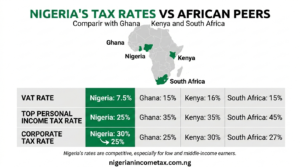
Nigeria’s VAT rate: 7.5% (unchanged under the 2026 reforms).
How Nigeria compares with African peers:
| Country | VAT Rate |
|---|---|
| Nigeria | 7.5% |
| Ghana | 15% |
| Kenya | 16% |
| South Africa | 15% |
Nigeria now has the lowest VAT rate among its key regional peers. This is a deliberate choice to keep the cost of goods and services lower for everyday Nigerians. The reforms also zero-rated food and basic consumables, and exempted healthcare services, medicines, education services, and passenger road transport from VAT entirely, as detailed in the PwC Nigeria tax summary analysis of the 2025 tax legislation.
Speaking at a national stakeholders’ discourse in Abuja, Taiwo Oyedele, chairman of the Presidential Fiscal Policy and Tax Reforms Committee, emphasized that these categories account for a large chunk of spending for the average Nigerian and nearly all consumption for low-income earners, meaning the measures should have a tangible impact on living costs. His full remarks were covered in the Thebusiness.ng article on tax reforms.
The difference between income tax and VAT article explains why both exist and how they serve different purposes.
Personal Income Tax: Moderately Progressive
Nigeria’s 2026 personal income tax rates:
– First ₦800,000: 0%
– Next ₦2.2 million: 15%
– Next ₦9 million: 18%
– Next ₦13 million: 21%
– Next ₦25 million: 23%
– Above ₦50 million: 25%
How top rates compare regionally:
| Country | Top Personal Income Tax Rate |
|---|---|
| Nigeria | 25% |
| Ghana | 35% |
| Kenya | 35% |
| South Africa | 45% |
Nigeria’s top rate of 25% is significantly lower than most of our African peers. The reforms were designed to make the system fairer, simpler, and more growth-friendly, countering perceptions that the government is piling new levies on citizens. Comparative data is available in the OECD Revenue Statistics in Africa 2024 publication, which tracks tax rates across the continent.
Oyedele noted that personal income tax contributes less than 8% of total tax take in Nigeria versus a global average of about 30%. Many Nigerians make expensive tax mistakes that increase their effective rate beyond what they should pay.
The current income tax rates guide breaks down exactly how these rates apply across different income levels.
Corporate Tax: Competitive for Small Business
Nigeria’s company income tax: 30% for large companies, with a planned reduction to 25%.
Small company rate: 0% for companies with turnover ≤ ₦50 million and fixed assets ≤ ₦250 million.
Regional comparison:
| Country | Corporate Tax Rate | Small Company Rate |
|---|---|---|
| Nigeria | 30% (going to 25%) | 0% |
| Ghana | 25% | 3% of turnover |
| Kenya | 30% | 3% of turnover |
| South Africa | 27% | 0% |
Oyedele explained that the reform’s pro-growth design focuses on wider exemptions for small companies to free up capital for reinvestment and hiring, as detailed in the KPMG Nigeria analysis of the 2025 tax reform bills.
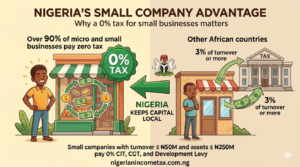
If a company’s annual turnover is ₦100 million or below (and meets the fixed-asset condition of not more than ₦250 million), the law treats it as a small company, granting major reliefs. This means over 90 percent of micro and small businesses will be out of the “tax-paying” bracket for major taxes.
The corporate income tax guide covers how companies can navigate this transition.
Capital Gains Tax: A Major Shift
One of the most significant changes in the 2026 reforms is the capital gains tax (CGT) increase.
Nigeria’s new CGT rate: 25% (up from 10%), effective January 2026.
How it applies: The 25% rate applies only to net capital gains exceeding ₦150 million, and investors can offset losses against gains. CGT will not apply if proceeds from equities are reinvested in equities within the same year, provided the reinvestment is in shares of a Nigerian company.
Regional CGT comparison:
| Country | Capital Gains Tax Rate |
|---|---|
| Nigeria | 25% (on gains > ₦150M) |
| Rwanda | 10% |
| Kenya | 15% |
| Morocco | 20% |
| South Africa | 21.6% (corporate) / 18% (individual) |
| Uganda | 40% (individual) |
| Ghana | 25% |
According to the Presidential Committee on Fiscal Policy and Tax Reforms, chaired by Taiwo Oyedele, the new design aligns Nigeria’s CGT with its corporate income tax rate and introduces fairness into the system by ensuring that only genuine profits are taxed.
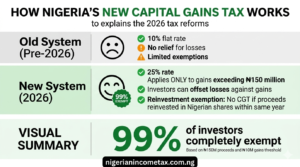
“Under the old regime, capital gains on shares were taxed at a flat rate of 10%, with no relief for capital losses and limited exemptions. The new regime introduces progressive taxation, where gains are taxed based on the payer’s income band, similar to practices in the U.S., U.K., South Africa, Ghana, and Brazil,” Oyedele said. This was extensively reported in the Premium Times coverage of the new capital gains tax regime.
Oyedele further clarified that all investors in the capital market are eligible for capital gains tax exemption with over 99 percent exempted unconditionally based on a threshold of ₦150 million proceeds and ₦10 million gains in any 12 months’ period.
The capital gains tax vs income tax article explains the distinction between these two types of taxation.
Tax-to-GDP Ratio: We Collect Very Little
Here’s where the comparison gets uncomfortable.
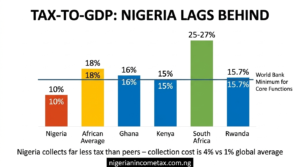
Tax-to-GDP ratio measures how much a country collects in taxes relative to the size of its economy.
| Country | Tax-to-GDP Ratio |
|---|---|
| Nigeria | ~10% |
| Ghana | ~16% |
| Kenya | ~15% |
| Senegal | ~20% |
| South Africa | ~25-27% |
| Rwanda | ~15.7% |
Timothy Siloma, partner in tax reporting and strategy at PwC Nigeria, noted that the national tax-to-GDP ratio is about 10 percent, compared with the African average of 18 percent. Meanwhile, the cost of tax collection stands at 4 percent, far above the global average of 1 percent. “This is clearly unsustainable,” Siloma said at a PwC webinar on Tax Technology and E-invoicing, as covered in the PwC Nigeria tax technology webinar report.
The government is targeting an 18% tax-to-GDP ratio through a two-pillar reform strategy combining legislative restructuring with digital infrastructure to drive automated, data-led compliance. PwC estimates that Nigeria’s ratio could rise from 9.5 percent to 10.2 percent in 2026 and reach 12.5 percent by 2027.
Nigeria remains a regional outlier, sitting well below the 15 percent benchmark cited by the World Bank as the minimum required to fund core government functions, as detailed in the World Bank taxation overview.
Non-Tax Revenue: The Untapped Opportunity
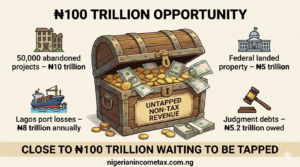
While the tax reforms are significant, experts point out that non-tax revenue remains largely untapped.
Nigeria’s 2025 budget figures:
– Total expenditure: ₦54.99 trillion
– Projected revenue: ₦41.81 trillion
– Deficit: ₦13.08 trillion (approximately 31% of total government revenue)
The constitutional framework already provides for extensive non-tax revenue opportunities. Section 162 of the Constitution defines the Federation’s “revenue” to include any income or return accruing to the Government of the Federation from any source.
Expert estimates suggest Nigeria could generate close to ₦100 trillion from various non-tax sources, including asset monetization, port infrastructure, and judgment debts, as analyzed in the ThisDay investigation into untapped non-tax revenue.
Residency Rules: Nigeria Joins Global Standards
The 2026 reforms brought Nigeria’s residency rules in line with international norms.
Under the Nigeria Tax Act 2025, you’re a resident if you:
- Are domiciled in Nigeria (your permanent home is here)
- Have a permanent home available for your use in Nigeria
- Spend 183 days or more in Nigeria
- Have substantial economic or immediate family ties here
This “substantial ties” test is common in many countries. The UK, Australia, and Canada all use similar rules to prevent wealthy individuals from living abroad while maintaining deep connections to the country. The OECD guidance on tax residency provides international context for these rules.
For Nigerians living abroad with family and property still here, this means their worldwide income may now be taxable in Nigeria. That’s a significant change that brings us closer to how countries like the US and UK tax their citizens.
The state of residence rule explains this in detail.
Global Minimum Tax: Nigeria Aligns with OECD
One of the biggest international tax developments in recent years is the OECD Pillar 2 framework, which establishes a 15% global minimum tax for large multinational corporations.
Nigeria’s 2026 reforms adopt this rule for:
- Nigerian companies with turnover exceeding ₦20 billion
- Multinational enterprises
This measure prevents aggressive tax planning and ensures that profitable companies contribute their fair share to national development. However, Nigeria has not signed any of the multilateral agreements on tax models for curtailing BEPS, especially those relating to Pillars One and Two, though the Federal Government has incorporated most of the suggested tax models into local legislation. The OECD Pillar Two model rules provide the international framework.
The minimum tax guide covers how this works for both local and multinational companies.
Non-Resident Company Taxation: A Departure from International Norms
The new tax laws introduce significant changes for non-resident companies that depart from standard OECD principles.
Under Section 17 of the Nigeria Tax Act 2025, profits derived from any trade, business, profession or vocation carried on by a non-resident person are taxable in Nigeria where “payment is made by a person resident in Nigeria or a permanent establishment of a non-resident person in Nigeria, in respect of services furnished from outside of Nigeria to a resident of Nigeria.”
This provision extends taxation to situations where there is an absence of economic activities deployed in Nigeria, which could lead to economic double taxation. Where a non-resident company has a permanent establishment or significant economic presence in Nigeria, even if services are provided from outside Nigeria, the company would be required to register and file annual income tax returns in Nigeria and pay income tax not less than 4% of gross revenue derived from the country..
Tax Administration: Digital Transformation
The institutional reforms are equally transformative. The Federal Inland Revenue Service has been renamed the Nigeria Revenue Service (NRS), reflecting its expanded responsibilities and national scope.
Value Added Tax (VAT) administration receives a significant boost through mandatory e-invoicing and fiscalization rules, bringing Nigeria’s tax administration into the digital age.
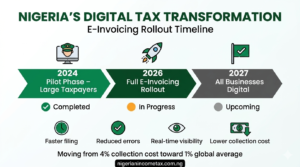
Mohammad Bawa, e-invoicing project manager at the NRS, said the rollout began in 2024 and is being implemented in phases, starting with the country’s largest taxpayers. The LIRS e-invoicing guidelines provide practical details for businesses.
For companies, the reforms signal a shift away from manual processes. Kenneth Erikume, tax reporting and strategy lead at PwC Nigeria, said companies that fail to digitise risk falling behind in an increasingly automated compliance environment.
Perhaps most significantly, the reforms introduce a Tax Ombudsman office to provide independent arbitration for tax-related complaints, positioning Nigeria as a progressive early adopter of modern tax administration practices in Africa while ensuring taxpayer rights are protected.
The how to file income tax guide reflects this simplicity with step-by-step instructions anyone can follow.
Tax Morale: The Trust Factor
As compliance efforts intensify, attention is shifting from revenue collection to institutional capacity and public trust.
The challenge for the NRS in 2026 is tax morale. When taxpayers see that debt servicing and recurrent costs are fully funded, while capital projects like roads and hospitals are deferred, the willingness to comply drops.
In 2023, for instance, only about ₦2.2 trillion of the ₦6.23 trillion allocated to capital projects was released, despite revenue targets being met. Debt servicing has further narrowed fiscal flexibility, with actual debt service rising to ₦12.63 trillion in 2024, exceeding the original budget provision of ₦8.27 trillion.
Adi Bongo, an economist and public affairs analyst, said Nigeria’s long dependence on oil revenue has weakened accountability. “Taxation gives citizens the moral right to question government spending. Without it, there’s no real democracy,” Bongo said in an interview on ARISE News, covered in the ARISE News interview on taxation and democracy.
Countries that rely more heavily on domestic revenue tend to face stronger pressure to deliver results. Rwanda, for example, combines a tax-to-GDP ratio of about 15.7 percent with extensive digital tax systems, transparent reporting of tax expenditures, and strong audit follow-through.
Avoiding common tax mistakes helps build trust in the system from the taxpayer side.
What Nigeria Does Better Than Most
After all the comparisons, here’s where Nigeria genuinely excels:
1. Low VAT rate – At 7.5%, we’re among the lowest globally and lowest in Africa. This keeps basic goods more affordable.
2. Small company exemption – 0% tax for qualifying small companies is genuinely world-class, with over 90% of micro and small businesses outside the tax-paying bracket.
3. Rent relief – 20% deduction up to ₦500k is genuinely progressive and rare globally.
4. Minimum wage protection – The ₦800,000 threshold means minimum wage earners pay zero tax when they claim their reliefs.
5. Capital market incentives – Over 99% of investors are exempt from capital gains tax unconditionally.
6. Tax Ombud – New in 2026, but a genuine innovation for Africa. Independent complaint resolution builds trust.
7. Zero VAT on essentials – Food, healthcare, education, and transport are VAT-exempt, protecting low-income households.
Where We Still Need to Catch Up
1. Tax-to-GDP ratio – At ~10%, we collect far less than the African average of 18%.
2. Collection efficiency – Cost of collection at 4% is far above the global average of 1%.
3. Non-tax revenue – We’re leaving billions in potential revenue from assets, judgment debts, and ports untapped.
4. Trust in the system – Many Nigerians still see tax as money taken rather than services funded. Debt servicing consuming 45% of projected revenue doesn’t help.
5. Digital infrastructure – E-invoicing is coming, but implementation is still in progress.
The Bottom Line
So how does Nigeria’s tax system compare with other countries?
The good: Our VAT is Africa’s lowest at 7.5%. Our top personal income tax rate of 25% is lower than Ghana, Kenya, and South Africa. Small companies enjoy zero tax, putting us alongside South Africa as regional leaders. The 2026 reforms bring us closer to international standards in residency rules, global minimum tax, and administrative simplicity.
The challenging: We collect far too little revenue—about 10% of GDP versus the African average of 18%. Our collection cost is four times the global average. And trust in the system remains low, with debt servicing consuming nearly half of projected revenue.
The opportunity: The 2026 reforms create a foundation for genuine improvement. Simpler laws, clearer rules, independent complaint resolution, and digital filing all point in the right direction. The government is betting that greater transparency and real-time visibility will reduce reliance on reactive audits and improve revenue stability.
Nigeria doesn’t need to copy any country’s tax system. We need a system that works for Nigeria—that collects enough revenue fairly, that protects the vulnerable while asking more from those who can afford it, and that citizens trust enough to comply willingly.
As Oyedele put it: “When we say the economy is improving, it must mean something to households and businesses; macro gains must translate into micro outcomes.”
Last updated: March 2026
This article reflects the provisions of the Nigeria Tax Act 2025 (effective January 2026), the Nigeria Tax Administration Act 2025, and international tax data from OECD, PwC, and KPMG sources.
Leave a Reply