
You negotiated a salary of ₦250,000 per month. You signed the offer letter. You calculated your budget. Then the first payslip arrived, and the number at the bottom was… ₦187,000.
What happened?
Between your gross salary and what hits your bank account, several things occur. Tax is the biggest, but it’s not the only one. Pension contributions, NHF deductions, and reliefs all play a role in determining your final take-home pay.
Understanding exactly how income tax affects your salary isn’t just about knowing what you lose. It’s about verifying that you’re losing the right amount—not too much, not too little. Because errors happen, and when they do, it’s your money on the line.
Let’s walk through the journey from gross salary to net pay, with real numbers, so you can track exactly where your money goes.
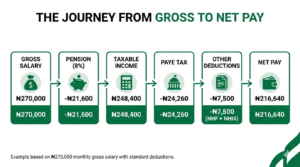
The Journey from Gross to Net
Your take-home pay is what remains after a series of deductions. Here’s the complete path:
Gross Salary → Pension Contributions → Taxable Income Calculation → PAYE Deduction → Other Deductions → Net Pay
Each step matters. If any step is wrong, your final number is wrong.
Understanding how personal income tax in Nigeria is structured helps you see where each piece fits in the bigger picture.
Step 1: Start with Gross Salary
Your gross salary is the full amount your employer agrees to pay you before any deductions. This includes:
- Base salary
- Housing allowance
- Transport allowance
- Other cash allowances
- Bonuses and commissions
Example:
– Base salary: ₦200,000
– Housing allowance: ₦50,000
– Transport allowance: ₦20,000
– Gross monthly salary: ₦270,000
Not all of this is taxable. Some allowances have exemptions, and pension contributions come off before tax is calculated.
If you want to verify your deductions, it’s important to learn how PAYE is calculated in Nigeria so you won’t have any confusion.
Step 2: Deduct Pension Contributions
Under the Pension Reform Act, employees in the formal sector contribute a minimum of 8% of their basic salary, housing, and transport allowances to their Retirement Savings Account (RSA). This is confirmed by the National Pension Commission official guidelines.
This contribution is deducted before tax is calculated, which means it reduces your taxable income.
Continuing the example:
– Qualifying income (basic + housing + transport): ₦200,000 + ₦50,000 + ₦20,000 = ₦270,000
– Pension contribution (8%): ₦270,000 × 8% = ₦21,600
– Income after pension: ₦270,000 – ₦21,600 = ₦248,400
This ₦21,600 goes into your pension account, grows tax-free, and reduces the income on which you pay tax today.
The reliefs and allowances that reduce income tax guide covers all eligible deductions in detail.
Step 3: Calculate Annual Taxable Income
PAYE is calculated on an annual basis, then divided into monthly installments. So we need to annualize your income after pension.
Monthly income after pension: ₦248,400
Annual income after pension: ₦248,400 × 12 = ₦2,980,800
Now we apply the ₦800,000 tax-free threshold and any eligible reliefs.
Apply the ₦800,000 Threshold
– Annual income: ₦2,980,800
– Minus ₦800,000 = ₦2,180,800 chargeable income
Apply Rent Relief (if applicable)
If you have a valid tenancy agreement and proof of payment, you can deduct 20% of your annual rent, up to ₦500,000.
Assume annual rent of ₦1,200,000:
– Rent relief: 20% × ₦1,200,000 = ₦240,000
– Chargeable income after rent relief: ₦2,180,800 – ₦240,000 = ₦1,940,800
Additional Allowable Deductions
You can also deduct:
- Life insurance premiums: For self and spouse, with registered insurance companies
- Mortgage interest: Interest on loans for owner-occupied homes
- NHF contributions: 2.5% of basic salary (if you opt in)
- NHIS contributions: 5% of basic salary (employee portion)
For this example, we’ll assume these are claimed and properly documented.
Step 4: Apply the Progressive Tax Rates
Now we apply the 2026 tax bands to the chargeable income as established in the Nigeria Tax Act 2025:
| Annual Taxable Income Bracket | Rate |
|---|---|
| First ₦800,000 | 0% |
| Next ₦2,200,000 (₦800,001 – ₦3,000,000) | 15% |
| Next ₦9,000,000 (₦3,000,001 – ₦12,000,000) | 18% |
| Next ₦13,000,000 (₦12,000,001 – ₦25,000,000) | 21% |
| Next ₦25,000,000 (₦25,000,001 – ₦50,000,000) | 23% |
| Above ₦50,000,000 | 25% |
For our example (₦1,940,800 chargeable income):
- First band (0%): Already accounted for in the ₦800,000 threshold
- Second band (15% on ₦800,001 – ₦3,000,000): ₦1,940,800 falls entirely within this band
- Tax calculation: ₦1,940,800 × 15% = ₦291,120 annual tax
Monthly PAYE: ₦291,120 ÷ 12 = ₦24,260
For a visual breakdown of how different income levels are affected, the current income tax rates in Nigeria table shows examples across all brackets.
Step 5: Apply Other Deductions
After PAYE, other deductions may apply:
- NHF (National Housing Fund): 2.5% of basic salary (if you opt in). Note: NHF is technically mandatory under the NHF Act, but in practice, many private sector employers only deduct it if employees specifically request to participate. If deducted, it must be remitted to the Federal Mortgage Bank of Nigeria.
- NHIS (National Health Insurance Scheme): Employee portion is typically 5% of basic salary. Employer pays additional 10% (not deducted from your pay).
- Union dues: If you’re in a unionized role
- Loan repayments: If you have salary advances or employer loans
- Wage garnishments: Court-ordered deductions
- NSITF: 1% of monthly payroll is paid entirely by the employer. Do not deduct this from employee salaries.
Continuing the example (assuming standard deductions):
– Monthly gross: ₦270,000
– Minus pension: -₦21,600
– Minus PAYE: -₦24,260
– Minus NHF (2.5% of basic): -₦5,000 (if opted in)
– Minus NHIS (5% of basic): -₦10,000
– Net monthly salary: ₦209,140
Note: Your actual net pay may vary based on which deductions apply to your specific employment.
Minimum Wage Earner Example
A minimum wage earner (₦70,000/month = ₦840,000/year) can claim deductions to bring taxable income below the ₦800,000 threshold:
- Gross annual: ₦840,000
- Minus pension (8%): -₦67,200
- Minus NHF (2.5%): -₦21,000 (if opted in)
- Minus NHIS (5%): -₦42,000
- Minus rent relief: -₦100,000 (if applicable)
- Taxable income after deductions: below ₦800,000
- Result: Zero tax payable
Complete Examples Across Income Levels
Let’s run through three scenarios to see how tax affects different salary levels.
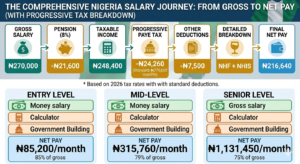
Example 1: Entry Level (₦100,000 monthly / ₦1.2 million annually)
- Gross monthly: ₦100,000
- Pension (8% of basic + allowances): Assume ₦8,000
- Income after pension: ₦92,000 monthly / ₦1,104,000 annually
- Minus ₦800,000 threshold: ₦304,000 chargeable
- Rent relief: None claimed
- Tax: ₦304,000 × 15% = ₦45,600 annual / ₦3,800 monthly
- Other deductions (NHF if opted in, NHIS): Assume ₦5,000
- Net monthly: ₦100,000 – ₦8,000 – ₦3,800 – ₦5,000 = ₦83,200
Example 2: Mid-Level (₦400,000 monthly / ₦4.8 million annually)
- Gross monthly: ₦400,000
- Pension (8%): ₦32,000
- Income after pension: ₦368,000 monthly / ₦4,416,000 annually
- Minus ₦800,000 threshold: ₦3,616,000
- Rent relief (₦1.5M annual rent): 20% = ₦300,000
- Chargeable: ₦3,316,000
- Tax: ₦2,200,000 × 15% = ₦330,000 (first ₦2.2M above threshold)
- Remaining: ₦1,116,000 × 18% = ₦200,880
- Annual tax: ₦530,880 / Monthly: ₦44,240
- Other deductions (NHF, NHIS): Assume ₦15,000
- Net monthly: ₦400,000 – ₦32,000 – ₦44,240 – ₦15,000 = ₦308,760
Example 3: Senior Level (₦1,500,000 monthly / ₦18 million annually)
- Gross monthly: ₦1,500,000
- Pension (8%): ₦120,000
- Income after pension: ₦1,380,000 monthly / ₦16,560,000 annually
- Minus ₦800,000 threshold: ₦15,760,000
- Rent relief (max): ₦500,000
- Chargeable: ₦15,260,000
- Tax: ₦2,200,000 × 15% = ₦330,000
- Next: ₦9,000,000 × 18% = ₦1,620,000
- Remaining: ₦4,060,000 × 21% = ₦852,600
- Annual tax: ₦2,802,600 / Monthly: ₦233,550
- Other deductions (NHF, NHIS): Assume ₦30,000
- Net monthly: ₦1,500,000 – ₦120,000 – ₦233,550 – ₦30,000 = ₦1,116,450
What If You Have Multiple Income Sources?
If you earn from more than one job or have side income, the calculation changes. Your principal employer applies the ₦800,000 threshold and basic rates. Your other employers deduct tax at the highest marginal rate (usually 25%) without applying reliefs.
At year-end, you’ll need to file a self-assessment to consolidate everything. If too much was deducted, you get a refund. If too little, you pay the balance.
Understanding how multiple income sources are taxed helps you avoid surprises at tax time.
The Impact of Bonuses on Take-Home Pay
Bonuses can significantly affect your take-home pay in the month they’re paid. Because PAYE is calculated on an annual cumulative basis, a large bonus can push you into a higher tax bracket for that month.
Example:
– Regular monthly salary: ₦300,000
– December bonus: ₦500,000
– Total December pay: ₦800,000
Your employer’s payroll system recalculates your cumulative earnings for the year and applies the appropriate tax rate to the total. Your December PAYE deduction will be higher than usual, but it should balance out over the full year.
If you spot an error, don’t assume it will fix itself—you need to know how to correct wrong tax deductions in Nigeria before the problem compounds.
Why Your Take-Home Pay Might Fluctuate
Even with a fixed salary, your net pay might vary from month to month. Common reasons:
- Pension contribution adjustments: If your basic salary changes, pension contributions change
- Rent relief application: Once you submit your rent documents, your tax adjusts
- Bonus months: Higher gross pay means higher tax
- Arrears payments: Catch-up payments for previous months
- Tax code changes: If your employer updates your tax basis
Your payslip should clearly show your gross pay, deductions, and net pay each month. Learning understanding your PAYE tax slip helps you read every line correctly.
Quick Take-Home Pay Estimator
Use this formula to estimate your net pay:
Gross Monthly – [Pension (8%)] – [PAYE] – [NHF (2.5% if opted in)] – [NHIS (5%)] – [Other Deductions] = Net Pay
For a rough estimate based on typical scenarios:
- If you earn ₦100,000–₦300,000: Net is roughly 80-85% of gross
- If you earn ₦300,000–₦1,000,000: Net is roughly 75-80% of gross
- If you earn above ₦1,000,000: Net is roughly 70-75% of gross
These are estimates only. For precise calculations, use the BusinessDay Nigeria personal income tax calculator or consult a tax professional.
How Industry Affects Take-Home Pay
Different sectors structure pay differently:
| Industry | Typical Allowances | Tax Impact |
|---|---|---|
| Banking/Finance | High housing/transport | More taxable allowances |
| Oil & Gas | Hazard pay, offshore premiums | Special calculations |
| Tech/Startups | Stock options, remote work | Complex valuations |
| Manufacturing | Shift allowances, overtime | Fluctuating monthly pay |
Knowing your industry’s patterns helps you anticipate your take-home pay more accurately.
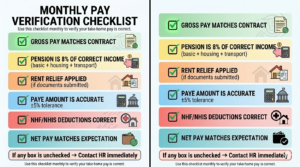
Monthly Pay Verification Checklist
Before accepting your payslip each month, verify:
- ☐ Gross pay matches your contract – Check base salary and all allowances
- ☐ Pension is 8% of correct income – Should be calculated on basic + housing + transport
- ☐ Rent relief appears – If you submitted documents, confirm deduction is applied
- ☐ PAYE amount is accurate – Compare with your calculation (±5% tolerance)
- ☐ NHF/NHIS deductions are correct – NHF 2.5% (if opted in), NHIS 5% of basic
- ☐ Net pay matches your expectation – After all deductions, is this what you expected?
If any box is unchecked → Contact HR immediately
Keeping proper records means having the documents needed for income tax filing ready when questions arise.
Common Take-Home Pay Errors
Error 1: Wrong Pension Basis
Some employers calculate pension on basic salary only, missing housing and transport allowances. This means you contribute less to pension than required by law, your taxable income is higher than it should be, and you pay more tax. Verify your pensionable income includes all three components.
Error 2: Missed Rent Relief
If you submitted rent documents and your payslip doesn’t show the deduction, follow up. Rent relief can save you hundreds of thousands in tax annually.
Error 3: Incorrect Tax Band Application
Some payroll systems still use old rates or forget the ₦800,000 threshold. Compare your deduction with the examples above.
Error 4: Multiple Employer Confusion
If you work multiple jobs and haven’t designated a principal employer, you might be underpaying tax and facing a large bill at year-end.
Error 5: Unclaimed Reliefs
Life insurance premiums, NHIS contributions, mortgage interest, and NHF contributions are all deductible—but only if you claim them with proper documentation.
To avoid these pitfalls, familiarizing yourself with common income tax mistakes Nigerians make can save you from costly errors.
When Take-Home Pay Changes Permanently
Certain life events permanently change your take-home pay:
- Marriage: May affect relief eligibility (life insurance for spouse becomes deductible)
- Buying a home: Mortgage interest becomes deductible
- Having children: No direct tax relief, but affects financial planning
- Changing jobs: New employer, new pension setup, new tax basis
- Relocating to another state: Different state tax rules may apply
- Turning 50: Enhanced pension contributions allowed
Understanding the state of residence rule for income tax in Nigeria helps if you move between states.
The Bottom Line
Your take-home pay is what funds your life. Understanding how tax affects it isn’t optional—it’s essential.
The journey from gross to net follows a clear path:
- Start with gross salary
- Deduct pension (8% of basic + housing + transport)
- Apply ₦800,000 threshold
- Deduct eligible reliefs (rent, life insurance, mortgage interest, NHF, NHIS)
- Apply progressive tax rates
- Deduct other contributions
- Arrive at net pay
Each step is an opportunity for error. Each error costs you money.
Check your payslip. Run the numbers. Ask questions. The money leaving your account is yours until the law takes it. Make sure it’s taking the right amount.
Last updated: March 2026
This article reflects the provisions of the Nigeria Tax Act 2025 (effective January 2026) and the Finance Act 2026.
External resources:
– For official confirmation of PAYE rates and calculations in your state, consult the Lagos State Internal Revenue Service official website.
– To verify pension contribution requirements and rates, refer to the National Pension Commission official guidelines.
– For a practical illustration of how the new tax bands affect different salary levels, use the BusinessDay Nigeria personal income tax calculator.
Leave a Reply