Tax rates change. Not every year, but often enough that relying on what you knew from a few years ago can cost you money.
The 2026 reforms brought the most significant changes in decades. The old Consolidated Relief Allowance is gone. The tax-free threshold is now a flat ₦800,000. The bands have shifted. And for the first time, the rates are clearly progressive from 0% to 25% with no complicated calculations in between.
Whether you’re an employee trying to verify your payslip, a business owner estimating your tax liability, or just someone who wants to understand where your money goes, knowing the current rates is your starting point.
Here are the complete 2026 income tax rates for individuals in Nigeria, with examples showing exactly how they apply.
The 2026 Tax Rates at a Glance
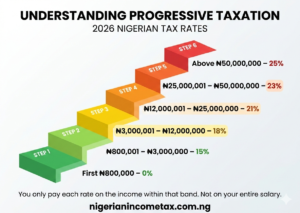
Under the Nigeria Tax Act 2025 (effective January 2026), the personal income tax rates are:
| Annual Taxable Income Bracket | Rate |
|---|---|
| First ₦800,000 | 0% |
| Next ₦2,200,000 (₦800,001 – ₦3,000,000) | 15% |
| Next ₦9,000,000 (₦3,000,001 – ₦12,000,000) | 18% |
| Next ₦13,000,000 (₦12,000,001 – ₦25,000,000) | 21% |
| Next ₦25,000,000 (₦25,000,001 – ₦50,000,000) | 23% |
| Above ₦50,000,000 | 25% |
Important: These rates apply to taxable income—what remains after you’ve deducted pension contributions, rent relief, and other allowable deductions from your gross income. The first ₦800,000 is tax-free for everyone, automatically.
For a complete explanation of what counts as taxable income, understanding taxable vs non-taxable income in Nigeria helps clarify what falls where.
How the Rates Work: The Cumulative Principle
Nigerian income tax is calculated on a cumulative basis. This means:
- Your tax is calculated on your total annual income
- The rates apply only to the portion of income within each band
- You don’t pay the higher rate on your entire income—only on the part above each threshold
Example:
– If you earn ₦2 million annually, you pay:
– 0% on the first ₦800,000
– 15% on the remaining ₦1.2 million
– Not 15% on the entire ₦2 million
This progressive system ensures higher earners pay more, but only on the portion of income above each threshold. Knowing how personal income tax in Nigeria is structured helps you see why this matters for your overall tax picture.
Rate Breakdown with Examples
Let’s walk through real examples at different income levels.
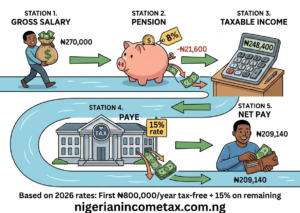
Example 1: Income Below ₦800,000 (No Tax)
Annual income: ₦600,000
– First ₦800,000: 0%
– Tax payable: ₦0
– Effective tax rate: 0%
If your total annual income is below ₦800,000, you pay no income tax. This includes minimum wage earners and part-time workers with modest earnings.
Example 2: Income ₦1.5 Million
Annual income: ₦1,500,000
– First ₦800,000: 0% = ₦0
– Remaining ₦700,000: 15% = ₦105,000
– Total tax: ₦105,000
– Effective tax rate: 7%
Someone earning ₦125,000 monthly pays about ₦8,750 per month in tax.
Example 3: Income ₦4 Million
Annual income: ₦4,000,000
– First ₦800,000: 0% = ₦0
– Next ₦2,200,000: 15% = ₦330,000
– Remaining ₦1,000,000: 18% = ₦180,000
– Total tax: ₦510,000
– Effective tax rate: 12.75%
This shows how the 18% band applies once income exceeds ₦3 million.
Example 4: Income ₦10 Million
Annual income: ₦10,000,000
– First ₦800,000: 0% = ₦0
– Next ₦2,200,000: 15% = ₦330,000
– Next ₦7,000,000 (up to ₦12M band): 18% = ₦1,260,000
– Total tax: ₦1,590,000
– Effective tax rate: 15.9%
The 18% band covers income from ₦3,000,001 to ₦12,000,000, so ₦7 million of this example falls in that band.
Example 5: Income ₦20 Million
Annual income: ₦20,000,000
– First ₦800,000: 0% = ₦0
– Next ₦2,200,000: 15% = ₦330,000
– Next ₦9,000,000: 18% = ₦1,620,000
– Next ₦8,000,000: 21% = ₦1,680,000
– Total tax: ₦3,630,000
– Effective tax rate: 18.15%
This example reaches the 21% band, which applies from ₦12,000,001 to ₦25,000,000.
Example 6: Income ₦40 Million
Annual income: ₦40,000,000
– First ₦800,000: 0% = ₦0
– Next ₦2,200,000: 15% = ₦330,000
– Next ₦9,000,000: 18% = ₦1,620,000
– Next ₦13,000,000: 21% = ₦2,730,000
– Next ₦15,000,000: 23% = ₦3,450,000
– Total tax: ₦8,130,000
– Effective tax rate: 20.3%
The 23% band applies from ₦25,000,001 to ₦50,000,000.
Example 7: Income ₦60 Million
Annual income: ₦60,000,000
– First ₦800,000: 0% = ₦0
– Next ₦2,200,000: 15% = ₦330,000
– Next ₦9,000,000: 18% = ₦1,620,000
– Next ₦13,000,000: 21% = ₦2,730,000
– Next ₦25,000,000: 23% = ₦5,750,000
– Remaining ₦10,000,000: 25% = ₦2,500,000
– Total tax: ₦12,930,000
– Effective tax rate: 21.55%
Income above ₦50 million attracts the top rate of 25%.
To see how these rates apply to your specific income, you can use the BusinessDay Nigeria personal income tax calculator for a real-time illustration.
Comparison: 2026 Rates vs Previous System
| Feature | Old System (Pre-2026) | 2026 System |
|---|---|---|
| Tax-free amount | CRA (variable: higher of ₦200k or 1% + 20% of income) | Flat ₦800,000 |
| First taxable band | 7% on first ₦300,000 | 15% on ₦800,001 – ₦3,000,000 |
| Number of bands | 6 | 6 |
| Top rate | 24% on income above ₦3.2M | 25% on income above ₦50M |
| Rent relief | NHF deduction (2.5% of income) | 20% of rent paid (up to ₦500k) |
The biggest change is simplicity. Under the old system, you had to calculate CRA first. Now, the ₦800,000 threshold is automatic, and claiming reliefs and allowances that reduce income tax can further lower your liability.
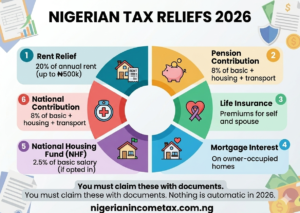
How Rent Relief Affects Your Effective Rate
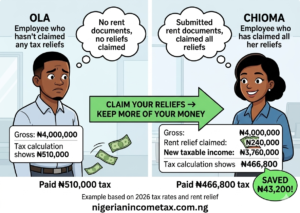
Rent relief can significantly lower your effective tax rate. Here’s how:
Without rent relief (₦4 million income):
– Tax: ₦510,000
– Effective rate: 12.75%
With rent relief (₦4 million income, ₦1.2 million annual rent):
– Rent relief: 20% × ₦1,200,000 = ₦240,000
– Taxable income reduces to ₦3,760,000
– Tax recalculation:
– First ₦800,000: 0%
– Next ₦2,200,000: 15% = ₦330,000
– Remaining ₦760,000: 18% = ₦136,800
– Total tax: ₦466,800
– Effective rate: 11.67%
– Savings: ₦43,200
If you pay rent and have valid documentation, claim this relief. It’s money back in your pocket.
How Pension Contributions Affect Your Rate
Pension contributions (8% of basic + housing + transport) come off before tax, reducing your taxable income and potentially lowering your tax band.
Example (₦4 million income with ₦3 million pensionable earnings):
– Pension contribution: ₦240,000
– Taxable income reduces to ₦3,760,000
– Same calculation as rent relief example above
– Tax savings: ₦43,200
Combine pension and rent relief, and the savings compound. To see the full calculation with all deductions, learning how PAYE is calculated in Nigeria ensures you don’t miss any savings.
Tax Rates for Different Filing Statuses
The rates above apply to individuals filing as:
- Single individuals
- Married individuals (filing separately)
- Sole proprietors
- Partners in partnerships
For companies, different rates apply:
| Company Type | Tax Rate |
|---|---|
| Small companies (≤ ₦50M turnover, ≤ ₦250M assets) | 0% |
| Medium/Large companies | 30% |
| Very Large companies (≥ ₦50Bn or multinational) | 15% minimum effective rate |
For companies, different rates apply. Understanding corporate income tax in Nigeria explained helps business owners navigate their obligations.
State-By-State Variations
While the federal tax rates are uniform, administration varies by state. You can verify your state’s specific requirements through the Lagos State Internal Revenue Service official website or your own state’s IRS portal.
While federal tax rates are uniform, which state receives your tax depends on where you live. The state of residence rule for income tax in Nigeria determines this, and it matters more than most people realize.
Common Questions About Tax Rates
Q: Do I pay tax on my entire income if I earn above ₦800,000?
A: No. Only the portion above ₦800,000 is taxable, and even then, only at the rates for each band. Someone earning ₦1 million pays tax on just ₦200,000 at 15%.
Q: What if my income fluctuates month to month?
A: PAYE is calculated on a cumulative basis. Your employer tracks your year-to-date earnings and applies the rates progressively. You won’t overpay in high months because earlier low months are factored in.
Q: Are bonuses taxed at a different rate?
A: No. Bonuses are added to your regular income and taxed at your marginal rate—the rate that applies to your highest band of income. They don’t have a separate rate.
Q: I have multiple jobs. How are my rates calculated?
A: Your principal employer applies the ₦800,000 threshold and basic rates. Other employers deduct at 25% without reliefs. You’ll need to file a self-assessment by March 31 to consolidate.
Q: Do these rates apply to rental income?
A: Yes. Rental income is added to your other income and taxed at the same progressive rates, after allowable deductions.
Q: What about cryptocurrency gains?
A: Crypto gains are now explicitly taxable as income. They’re added to your total income and taxed at these same rates.
For professional analysis of how these rates apply to different scenarios, the PwC Nigeria tax summary provides detailed technical guidance.
Historical Context: How Rates Have Changed
| Year | Tax-Free Threshold | Top Rate |
|---|---|---|
| 2020 | ₦30,000 (monthly) | 24% |
| 2021 | ₦30,000 (monthly) | 24% |
| 2022 | ₦30,000 (monthly) | 24% |
| 2023 | ₦30,000 (monthly) | 24% |
| 2024 | ₦30,000 (monthly) | 24% |
| 2025 | CRA system | 24% |
| 2026 | ₦800,000 (annual flat) | 25% |
The 2026 reform represents the most significant shift in over a decade, simplifying the system and raising the tax-free threshold substantially.
Planning Around the Rates
Understanding the rates helps you plan:
- If you’re near a threshold: Consider timing income or claiming deductions to stay in a lower band
- If you have control over payment timing: Deferring income to a later year might make sense if you expect lower income then
- If you’re self-employed: Accelerate deductible expenses into high-income years
The income tax for self-employed Nigerians guide offers strategies for business owners.
The Bottom Line
The 2026 tax rates are simpler and more transparent than the old system:
| Income Range | Rate | What It Means |
|---|---|---|
| Up to ₦800,000 | 0% | Everyone gets this tax-free |
| ₦800,001 – ₦3M | 15% | Basic rate for most workers |
| ₦3M – ₦12M | 18% | Mid-level professionals |
| ₦12M – ₦25M | 21% | Senior professionals |
| ₦25M – ₦50M | 23% | Executives |
| Above ₦50M | 25% | Top earners |
No more CRA calculations. No more confusion about what’s deductible. Just clear bands and rates.
Check your payslip against these rates. If something doesn’t match, ask questions. The money leaving your account is yours until the law takes it. Make sure it’s taking the right amount.
Last updated: March 2026
This article reflects the provisions of the Nigeria Tax Act 2025 (effective January 2026).
Leave a Reply