If you’ve ever tried to open a bank account, buy land, or bid for a government contract in Nigeria, you’ve probably been asked for your TIN.
But what exactly is a Tax Identification Number? Who needs one? How do you get it? And what happens if you don’t have one?
Let’s answer all of that—based on the Nigeria Tax Administration Act (NTAA) 2025 and current guidelines from the Nigeria Revenue Service (NRS) and State Internal Revenue Services.
What Is a TIN?
A Tax Identification Number (TIN) is a unique number assigned to every taxable person in Nigeria. It serves as your permanent tax identification for life—similar to a fingerprint for your tax records.
Under the Nigeria Tax Administration Act 2025, which took effect on January 1, 2026, registration for a TIN is mandatory for all individuals and entities earning income in Nigeria. You cannot be issued a TIN more than once, making it a reliable and consistent identifier across all tax-related matters.
Each taxpayer is assigned only one TIN, which is used for all tax transactions with the Nigeria Revenue Service (NRS), State Internal Revenue Services, and other government agencies. The system is designed to ensure that every taxpayer is properly captured within the tax net.
TINs are issued by the Nigeria Revenue Service (NRS) —formerly FIRS—for companies and federal taxpayers, and by State Internal Revenue Services for individuals and non-corporate entities.
The Federal Inland Revenue Service (Establishment) Act 2007 provides the legal basis for the TIN system, and this framework has been strengthened under the new tax reforms.
Knowing which State IRS handles your TIN registration starts with understanding the state of residence rule, which also determines where you pay tax.
Who Needs a TIN?
Under the NTAA 2025, the following persons are required to register for a TIN:
- Individuals earning taxable income in Nigeria
- Companies and incorporated businesses
- Partnerships and sole proprietorships
- Non-resident companies doing business in Nigeria
- Trustees and estates with taxable income
- Government ministries, departments, and agencies
If you are a salaried employee, your employer can register you for a TIN. Employers must ensure that all employees have a TIN and include it in their PAYE filings.
Having your TIN correctly linked to your identity is essential. In some states, individuals may be required to use their National Identification Number (NIN) when registering for a TIN, as the government moves toward linking all taxpayer records with a single identifier. This integration is part of the broader effort under the NTAA 2025 to ensure that all taxable individuals are captured in the tax net.
A TIN has far-reaching implications beyond taxation. It is required for:
- Opening bank accounts
- Land transactions and property purchases
- Bidding for government contracts
- Processing visas and travel documents
- Import and export operations
Many Nigerians have faced significant delays simply because they lacked a TIN. This is why understanding the complete how to file income tax process, which requires a TIN, is so important.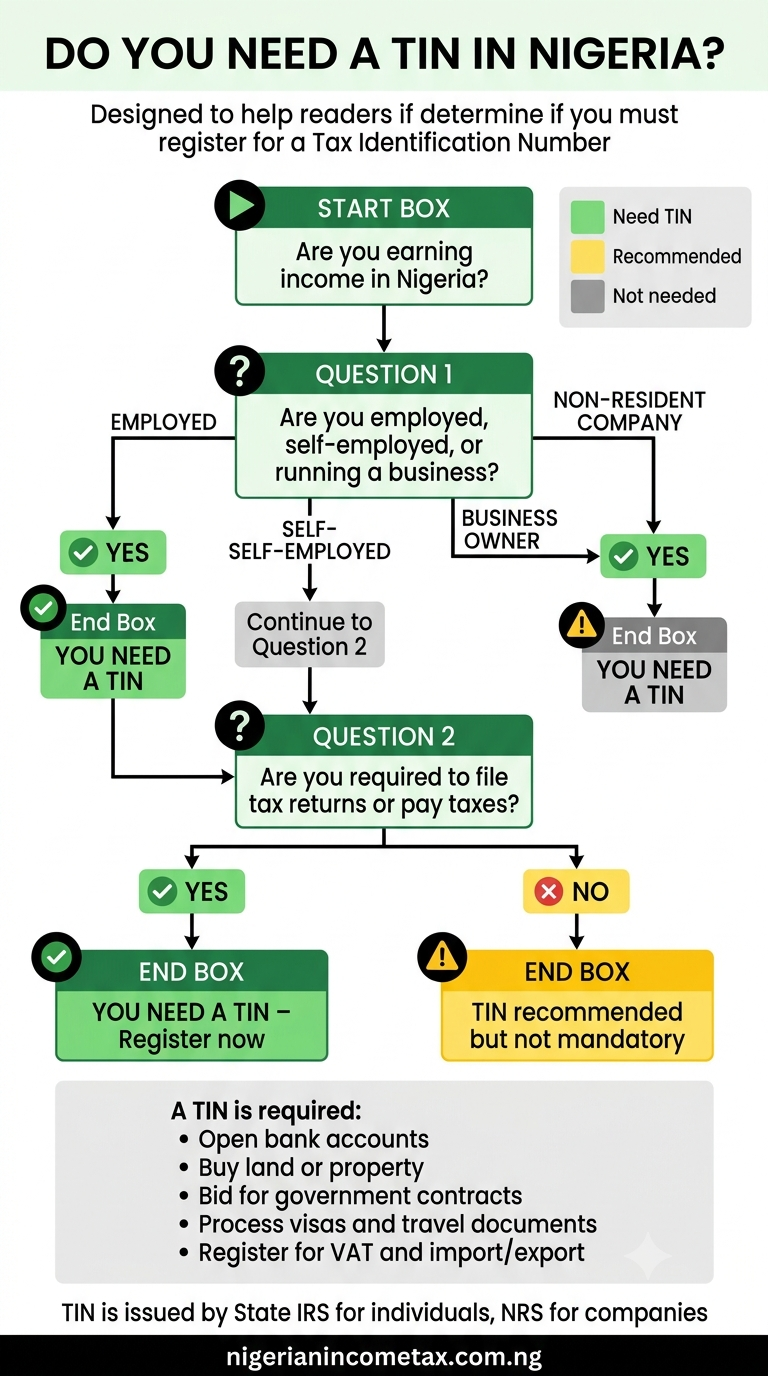
How to Register for a TIN
The registration process differs depending on whether you are an individual or a company.
Individuals (Self-Employed and Employees)
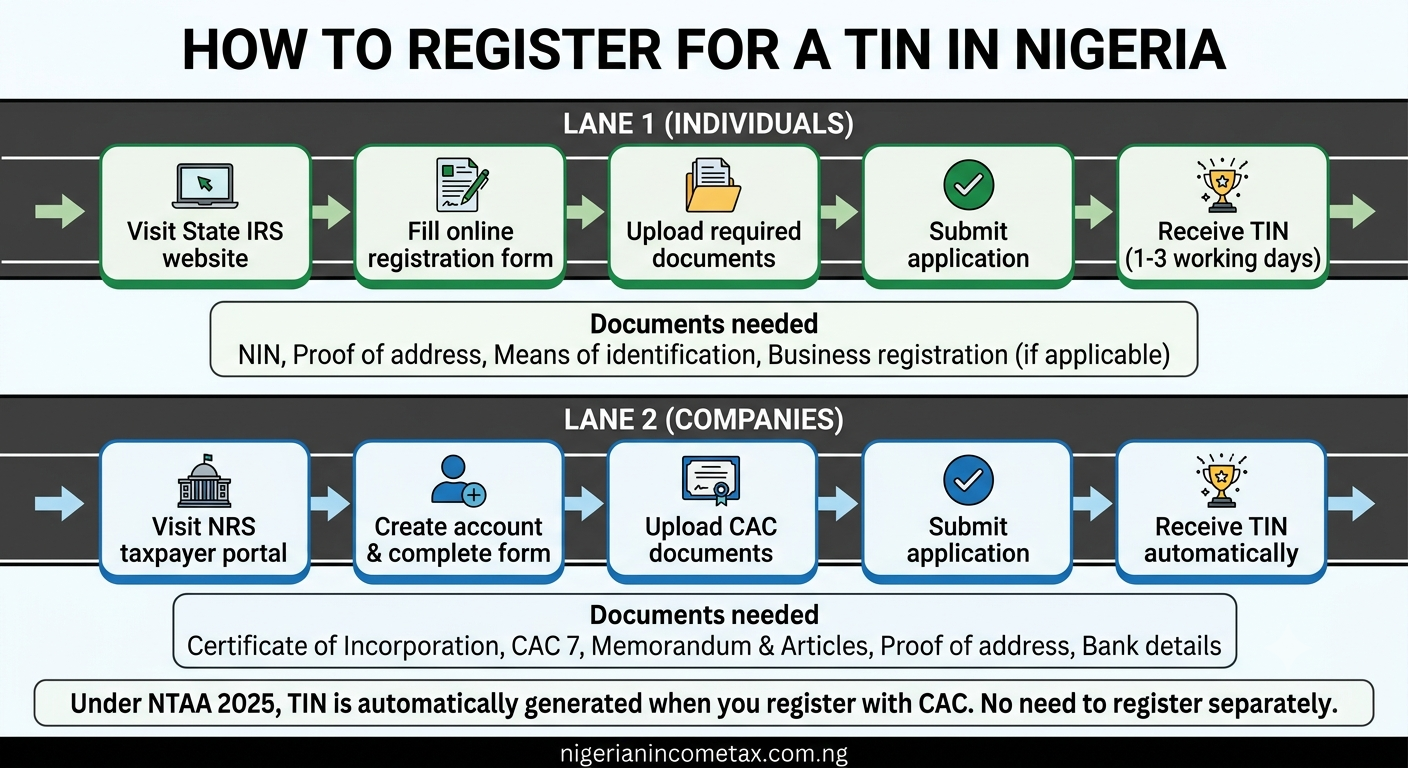
Individuals can register for a TIN through their State Internal Revenue Service.
Step 1: Visit the website of the State Internal Revenue Service in your state of residence.
Step 2: Navigate to the TIN registration portal.
Step 3: Fill out the online registration form. You will typically need to provide:
- Full name
- Date of birth
- Residential and business address
- National Identification Number (NIN)
- Phone number and email address
- Type of business or employment
Step 4: Upload required documents, such as:
- Proof of address (utility bill, tenancy agreement)
- Means of identification (NIN, driver’s license, international passport)
- Business registration documents (if applicable)
Step 5: Submit the application and wait for processing.
Most states now process TIN applications within 1-3 working days. Under the NTAA 2025, the registration process has been streamlined and standardized across states.
Companies and Businesses
Companies register for a TIN through the Nigeria Revenue Service.
Step 1: Visit the NRS taxpayer portal.
Step 2: Create an account and complete the online registration form.
Step 3: Submit the required documents:
- Certificate of Incorporation (CAC)
- Memorandum and Articles of Association
- Particulars of Directors (Form CAC 7)
- Proof of business address
- Bank account details
Step 4: Receive your TIN via email or download it from the portal.
Non-Resident Companies
Non-resident companies with a permanent establishment or significant economic presence in Nigeria must also register for a TIN. The process is similar to that for local companies but may require additional documentation related to foreign operations and tax treaties.
How to Check Your TIN
If you have already registered for a TIN but cannot remember it, you can retrieve it using the following methods:
Method 1: Online Verification
Use the NRS or State IRS online portal:
- Visit the NRS website (nrs.gov.ng) or your State IRS portal
- Navigate to the “Check TIN” or “Verify TIN” section
- Enter your personal details, such as NIN, email, or phone number
- Your TIN will be displayed if you are registered
Method 2: SMS Service
Some state IRS portals offer SMS verification:
- Send a text message with your NIN to the designated short code
- You will receive your TIN via SMS
Method 3: Contact Your State IRS
Visit or call your State Internal Revenue Service office. They will verify your identity and provide your TIN.
Method 4: Employer’s Payroll
If you are an employee, your payslip will include your TIN. Your employer is also expected to provide your TIN to the tax authority as part of the annual PAYE returns.
TIN Format in Nigeria
The format of your TIN depends on who issued it:
- Federal TIN (for companies): Generally starts with the letter “F” followed by numbers
- State TIN (for individuals): Starts with a number or letter indicating the state of registration
- Under the new NTAA 2025: A unified TIN format is being adopted. Each TIN now includes your National Identification Number (NIN) to create a single, unified identity for all tax matters.
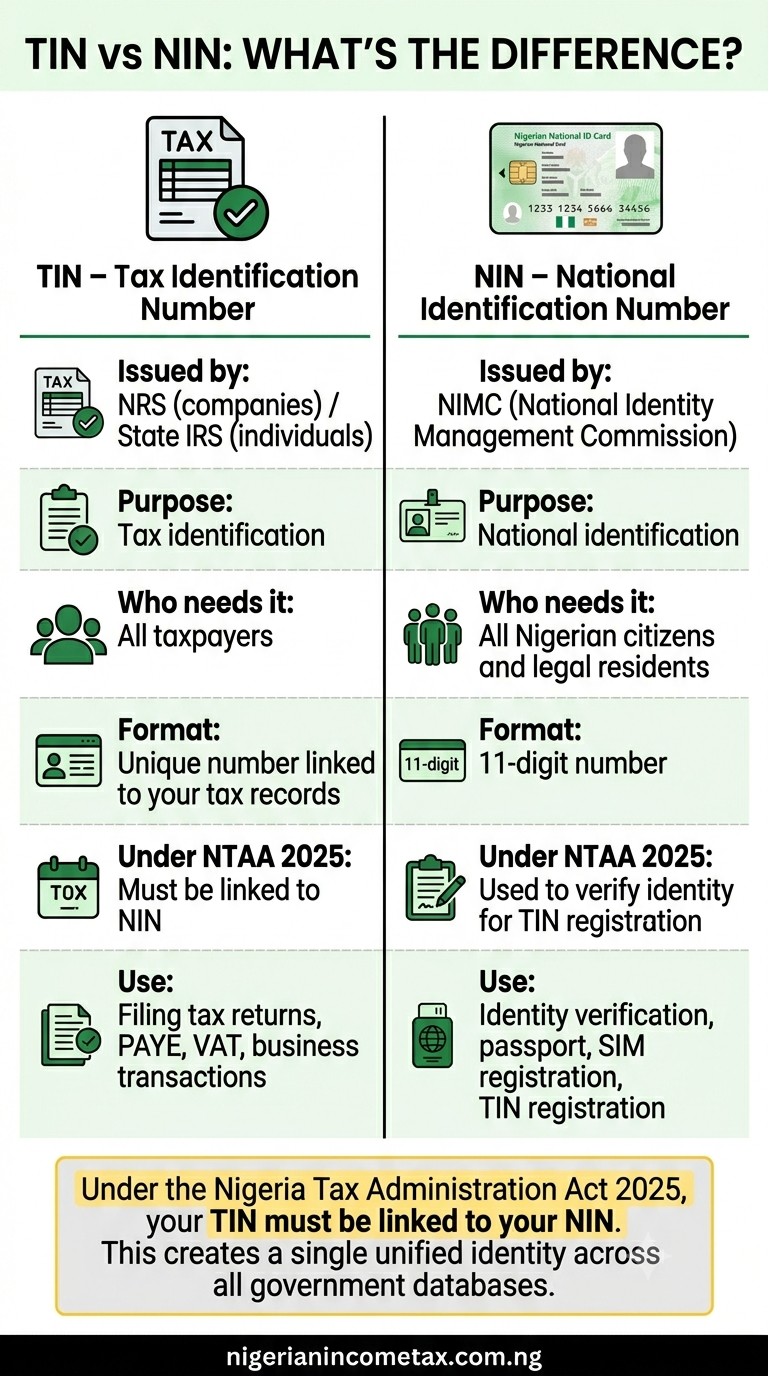
TIN vs NIN: What’s the Difference?
| Feature | TIN | NIN |
|---|---|---|
| Issued by | NRS (companies) / State IRS (individuals) | National Identity Management Commission (NIMC) |
| Purpose | Tax identification | National identification |
| Who needs it | All taxpayers | All Nigerian citizens and legal residents |
| Linking | Linked to NIN under new rules | Used to verify identity for TIN registration |
Under the NTAA 2025, your TIN must be linked to your NIN. This prevents individuals from holding multiple TINs across different states and ensures that all incomes are captured in the system.
TIN Under the 2026 Reforms
The Nigeria Tax Administration Act 2025 introduced several key changes to the TIN system:
1. Unified TIN Format
Each taxpayer is now assigned a single TIN that is valid across all states. This eliminates the confusion of having different TINs for different tax authorities.
2. Mandatory NIN-Linking
All TIN registrations now require a valid NIN. This ensures that each taxpayer has a single identity across all government databases.
3. Digital Registration
All TIN registrations must be completed online. Manual submissions are no longer accepted.
4. Automatic TIN Issuance
When you register a business with the Corporate Affairs Commission (CAC), a TIN is automatically generated and sent to you. This eliminates the need for a separate registration process.
5. Single TIN for Individuals and Companies
The new regulations prohibit multiple TINs for the same individual. If you are both a salaried employee and a business owner, you will use the same TIN for both.
Penalties for Not Registering for a TIN
Failure to register for a TIN is an offense under the NTAA 2025. Penalties include:
- Operating without a TIN: penalties may apply for each transaction carried out without a valid TIN
- Wrongful use of TIN: Falsifying TIN information can attract fines and potential prosecution
Many small business owners have been unable to access loans or government schemes simply because they had no TIN. When it comes to paying what you owe, the penalties for late or non-payment often begin with the absence of a TIN.
TIN and Your Business
For businesses, TIN is essential for:
- Filing corporate income tax returns
- Registering for VAT
- Withholding tax compliance
- Employee PAYE administration
- Import and export documentation
If you are a new business, you must have a TIN before you can open a corporate bank account or obtain a Tax Clearance Certificate (TCC). The earlier you register, the less likely you are to face administrative delays.
Common TIN Issues and How to Resolve Them
Issue 1: Multiple TINs
Some individuals accidentally register multiple TINs in different states. Under the NTAA 2025, only one TIN is valid. You must contact the State IRS where you hold the valid TIN to merge your records. Other TINs will be deactivated.
Issue 2: Lost TIN
Use the online verification portal or SMS service to retrieve your TIN. If all else fails, visit your State IRS office in person with a valid ID.
Issue 3: TIN Not Linking to NIN
Contact your State IRS to confirm that your NIN has been linked to your TIN. You may need to provide your NIN along with the application.
Issue 4: Employer Not Registering You
If your employer fails to register you for a TIN, you can register yourself directly with your State IRS. Your employer is legally required to ensure all employees are registered.
Important Documents Needed for TIN Registration
When registering for a TIN, keep these documents handy:
- For individuals: NIN, valid means of identification, proof of address
- For businesses: Certificate of Incorporation, Memorandum and Articles of Association, CAC forms, proof of business address
Having all the right paperwork ensures a smooth registration process. Understanding which documents needed for income tax filing applies to TIN registration can prevent unnecessary delays.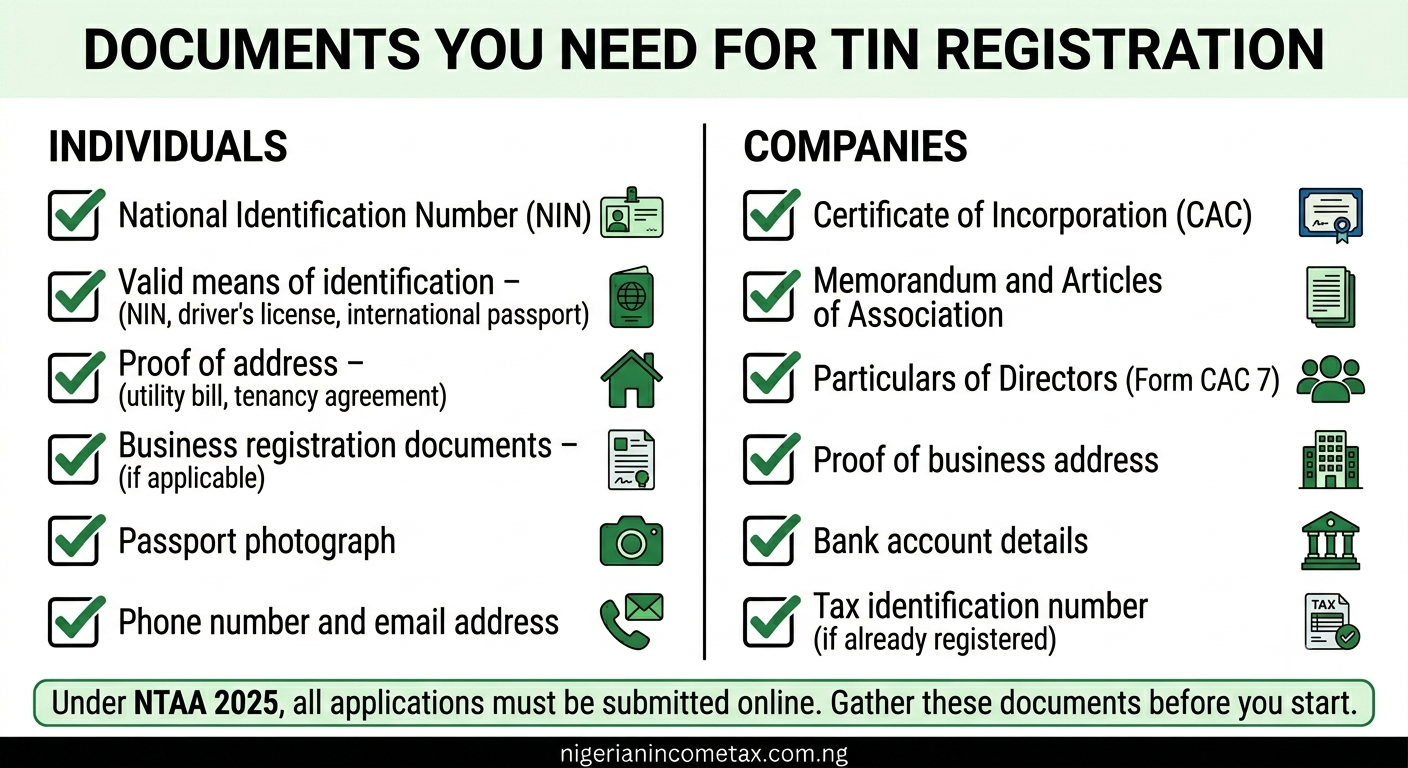
The Bottom Line
Your Tax Identification Number (TIN) is one of the most important numbers you will ever have in Nigeria. It follows you from job to job, business to business, and transaction to transaction.
The 2026 reforms made it easier to obtain and verify your TIN:
- Digital registration is now mandatory
- TIN is automatically generated for new businesses by CAC
- NIN linking ensures a single unified identity
- Online verification portals are available across states
If you do not have a TIN yet, register today through your State Internal Revenue Service or the Nigeria Revenue Service portal. It takes less than 30 minutes online—and saves hours of frustration later.
Leave a Reply