Filing income tax in Nigeria feels complicated—until you realize it’s not one process. It’s several processes, each designed for a different type of taxpayer.
Employees file one way. Self-employed people file another. Companies have their own rules entirely. And if you fall into multiple categories, you need to understand how they fit together.
The good news? The Nigeria Tax Administration Act (NTAA) 2025 and Nigeria Tax Act (NTA) 2025, effective from January 2026, made filing simpler. Consolidated systems, clearer deadlines, and digital platforms mean less confusion than ever before. But you still need to know which process applies to you.
Let’s walk through exactly how to file income tax in Nigeria, whether you’re an employee, self-employed, or running a business.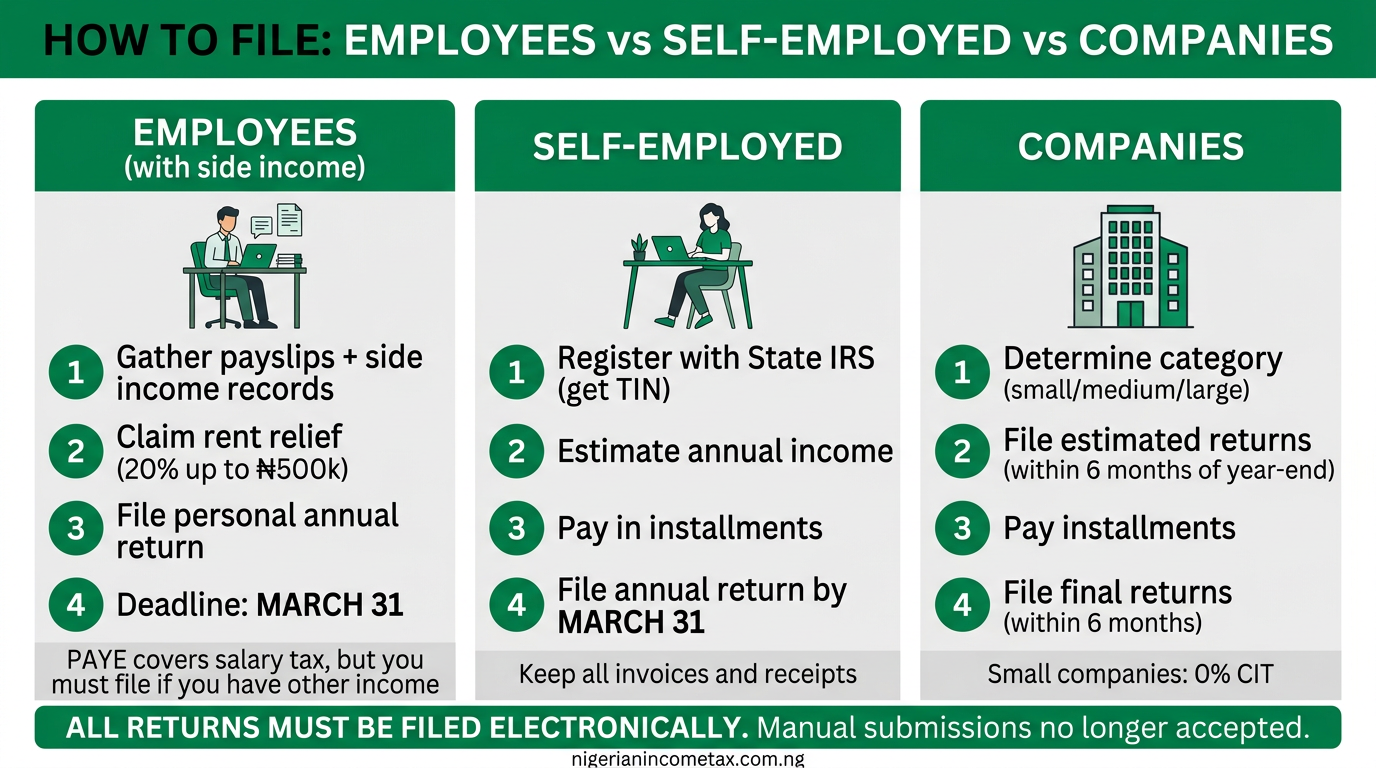
Who Needs to File?
The Lagos State Internal Revenue Service (LIRS) has reminded residents earning taxable income to file their 2025 individual annual tax returns on or before March 31, 2026. This applies to all taxable persons, including self-employed individuals, business owners, professionals, informal sector operators, and employees under PAYE.
As explained in a recent Nairametrics guide to the Nigeria Tax Act 2025, the new framework expands the tax net to include previously informal sectors. This means more people than ever before need to understand their filing obligations.
You MUST file if you:
- Are employed in Nigeria (your employer files on your behalf, but you may still need to file personally if you have other income)
- Run any business, registered or not
- Earn income from freelance work, side hustles, or gigs
- Receive rental income from property you own
- Earn dividends, interest, or royalties
- Trade crypto or other digital assets (now mandatory under the Nigeria Tax Administration Act 2025, which requires exchanges to report transactions linked to your TIN and NIN)
- Are a Nigerian resident earning foreign income
- Have multiple income sources that need consolidation
You MAY NOT need to file if:
- Your annual income is below ₦800,000 AND you have no other income sources
- You’re an NYSC member receiving only the federal allowance (₦33,000 monthly)
- You’re a student with no independent income
- Your income comes entirely from exempt sources (gifts, loans, inheritances)
But here’s the thing: even if you don’t owe tax, filing protects you. It creates a record. It proves your income sources. It makes future transactions—like getting a loan or buying land—much easier.
As Ayodele Subair, Executive Chairman of LIRS, stated during a press conference “Filing annual tax returns is not optional. It is a legal obligation under the Nigeria Tax Administration Act 2025.”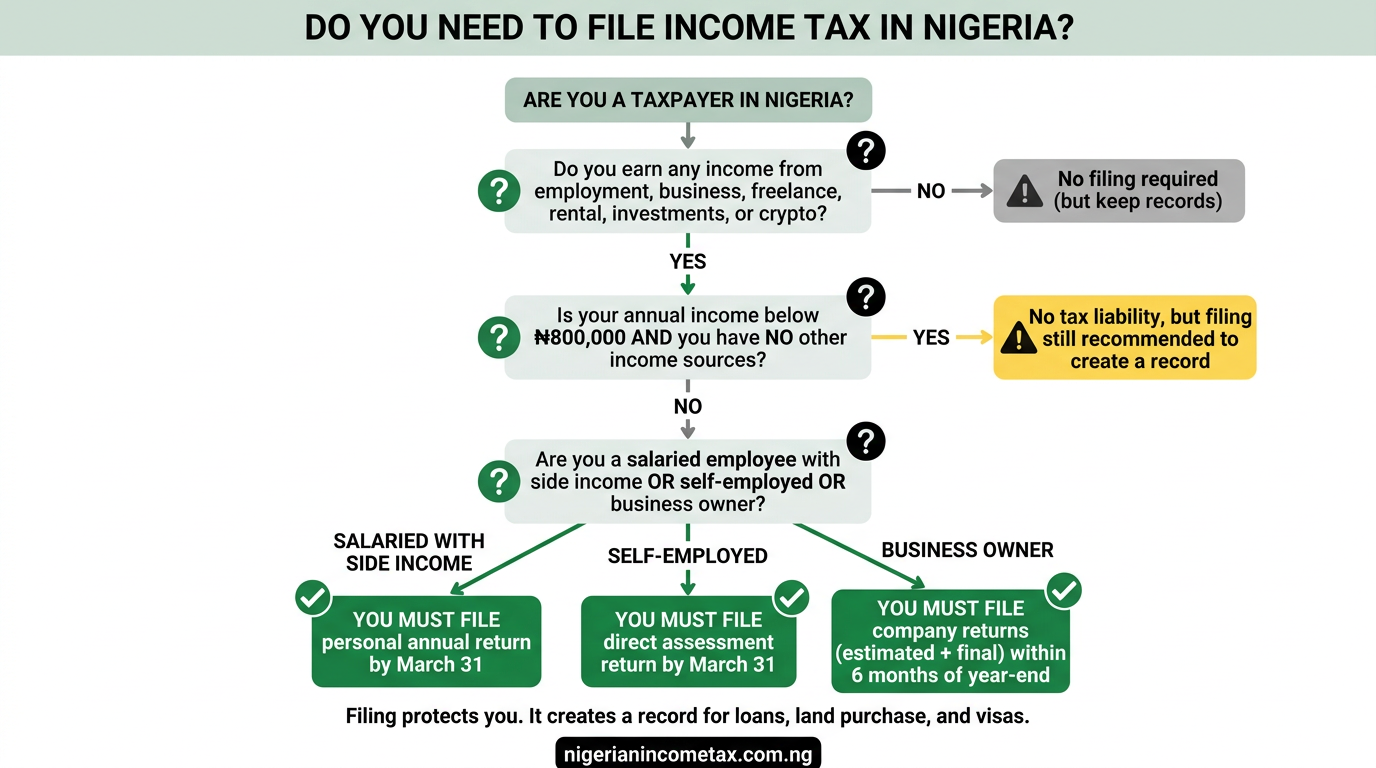
Before diving deeper, it helps to understand the broader picture of how personal income tax in Nigeria is structured. Many people make simple mistakes by assuming they’re exempt when they’re not.
The Two Main Filing Systems
Nigeria operates two parallel filing systems under the new tax regime.
1. PAYE (Pay-As-You-Earn) – For Employees
If you’re employed, your employer handles most of the work. They:
- Deduct tax monthly from your salary at progressive rates from 0% to 25%
- Remit it to your State Internal Revenue Service by the 10th of each month
- File annual returns on your behalf by January 31
You don’t submit a separate return just for your salary. Your employer does it.
But—and this is critical—if you have income outside your salary (rental income, freelance work, business profits), you must file a separate personal return consolidating everything.
According to the PwC Nigeria tax publications, employees with side income often make the costly error of assuming PAYE covers everything. It doesn’t. To avoid confusion, you might want to understand exactly how PAYE is calculated so you can verify your deductions.
2. Direct Assessment – For Self-Employed Individuals
If you’re self-employed, run a business as a sole proprietor, or have income outside employment, you file through direct assessment.
You register with your State Internal Revenue Service, estimate your annual income, and pay tax in installments. The system assumes you know your business best—but if your estimates are significantly wrong, expect questions.
Step-by-Step: How to File as an Employee (with Side Income)
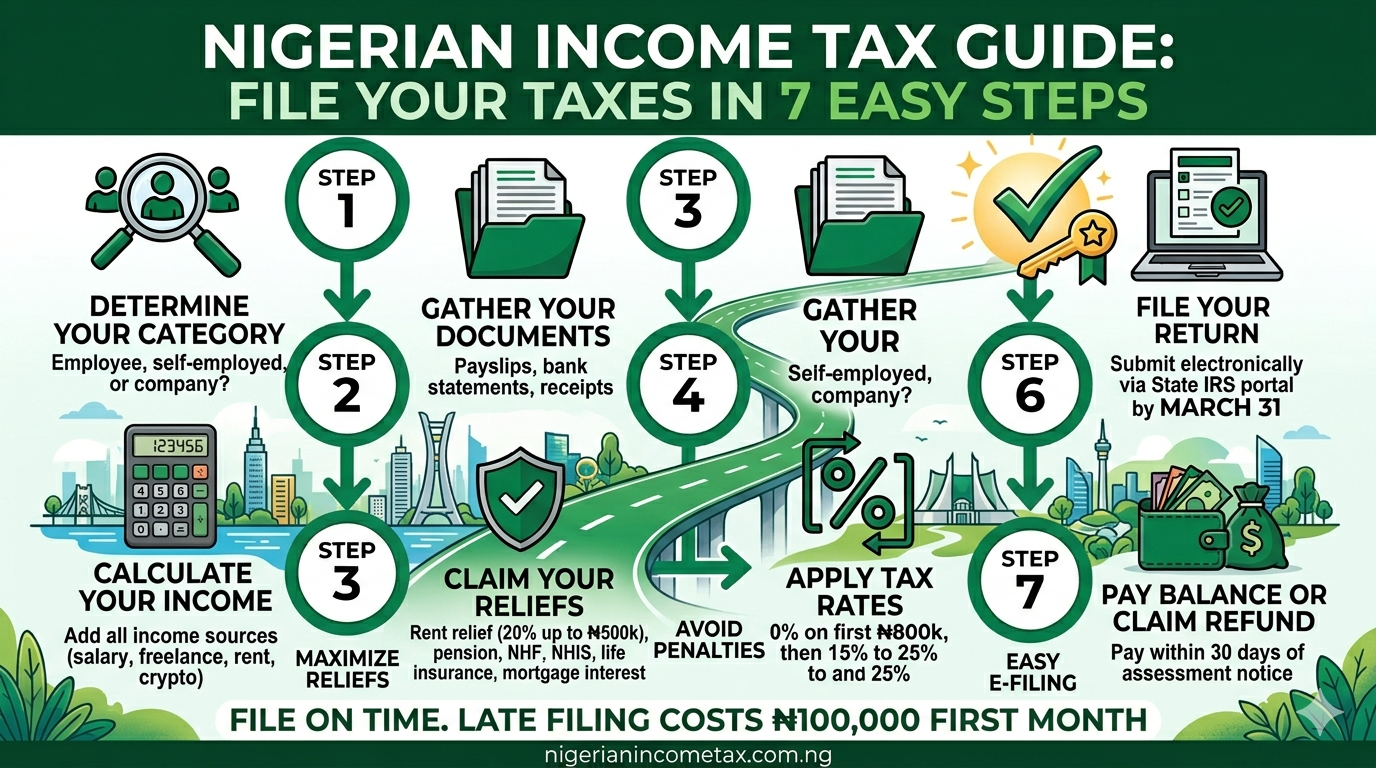
Step 1: Gather Your Documents
- All payslips from the tax year
- Records of any additional income (rental, freelance, crypto)
- Receipts for rent (if claiming rent relief)
- Pension, NHF, and NHIS contribution records
- Life insurance premium receipts
- Mortgage interest statements (if applicable)
Having all your paperwork ready before you start makes the process smoother. This includes everything from bank statements to tenancy agreements.
Step 2: Calculate Your Total Income
Add up everything:
- Salary (gross, before deductions)
- Business profits
- Rental income
- Investment income
- Crypto gains (now fully traceable under the new rules requiring exchanges to report all transactions)
Step 3: Claim Your Reliefs
Subtract:
- ₦800,000 tax-free threshold (automatic)
- Rent relief (20% of annual rent up to ₦500,000, with proof)
- Pension contributions (8% of basic + housing + transport)
- NHF contributions (2.5% of basic, if opted in)
- NHIS contributions (5% of basic)
- Life insurance premiums (self and spouse)
- Mortgage interest (on owner-occupied home)
Knowing which deductions apply to you can significantly lower your tax bill. The rules around what you can claim have changed recently, so it’s worth reviewing the latest reliefs and allowances available.
Step 4: Calculate Tax Using 2026 Rates
| Annual Taxable Income | Rate |
|---|---|
| First ₦800,000 | 0% |
| ₦800,001 – ₦3,000,000 | 15% |
| ₦3,000,001 – ₦12,000,000 | 18% |
| ₦12,000,001 – ₦25,000,000 | 21% |
| ₦25,000,001 – ₦50,000,000 | 23% |
| Above ₦50,000,000 | 25% |
Step 5: File Your Annual Return
Deadline: March 31 each year.
You file with your State Internal Revenue Service (the state where you reside). Most states now offer online portals. Lagos State, for example, has a fully digital eTax portal where taxpayers can register, file returns, upload supporting documents, and manage their tax profiles remotely.
If you’ve already paid tax through PAYE, this return reconciles what you’ve paid with what you actually owe. If you overpaid, you get a refund. If you underpaid, you pay the balance. Double-checking your calculations against the official tax rate tables helps avoid arithmetic errors.
Step-by-Step: How to File as Self-Employed
Step 2: Estimate Your Annual Income
At the beginning of each tax year (or within 90 days of starting business), submit an estimate of your expected income for the year. This is your basis for installment payments.
Be realistic. If your actual income ends up much higher than your estimate, you’ll face penalties and interest on the underpayment.
Step 3: Pay in Installments
Subject to Section 11 of the NTAA 2025, every person shall make payment of tax due on or before the due date of filing in one lump sum or in installments, provided that the final installment shall be paid on or before the due date of filing.
Step 4: Keep Records Throughout the Year
- Invoices and receipts
- Bank statements (banks report transactions exceeding ₦25 million monthly to tax authorities under the new framework)
- Expense records
- Asset purchases
Step 5: File Your Annual Return by March 31
This is your opportunity to reconcile your estimated payments with your actual income. If you overpaid, you get a refund. If you underpaid, you pay the difference.
For those working for themselves, the rules differ significantly from regular employment. Taking time to understand how filing works for self-employed individuals can prevent costly mistakes.
Step-by-Step: How to File Company Income Tax
Step 1: Determine Your Company Category
Under the new tax reforms, the thresholds for small company status have been raised. Qualifying small businesses are exempt from Companies Income Tax (CIT), Capital Gains Tax (CGT), and certain levies. Common thresholds cited include turnover between ₦50 million and ₦100 million, with fixed assets not exceeding ₦250 million.
| Category | Criteria | Tax Rate |
|---|---|---|
| Small Company | Turnover ≤ ₦100M AND assets ≤ ₦250M | 0% CIT, 0% CGT, exempt from certain levies |
| Medium/Large | Turnover > threshold | 30% CIT + other applicable taxes |
| Very Large | Turnover > ₦50B or multinational | 15% minimum effective tax rate |
Step 2: File Estimated Returns
Within six months of your accounting year-end, file an estimate of your income for the current year. This determines your installment payments.
Step 3: Pay Installments
Based on your estimate, pay tax in installments throughout the year. Tax charged by any assessment must be paid at the place stated in the notice of assessment within 30 days of service.
Step 4: File Final Returns
Within six months of your accounting year-end, file your final returns with actual figures. Include:
- Financial statements
- Tax computations
- Capital allowance schedules
- Evidence of taxes paid
Step 5: Pay Any Balance Due
If your final tax liability exceeds your installment payments, pay the balance by the filing deadline.
Company taxation has its own complexities. Familiarizing yourself with how corporate tax works can help you avoid common pitfalls.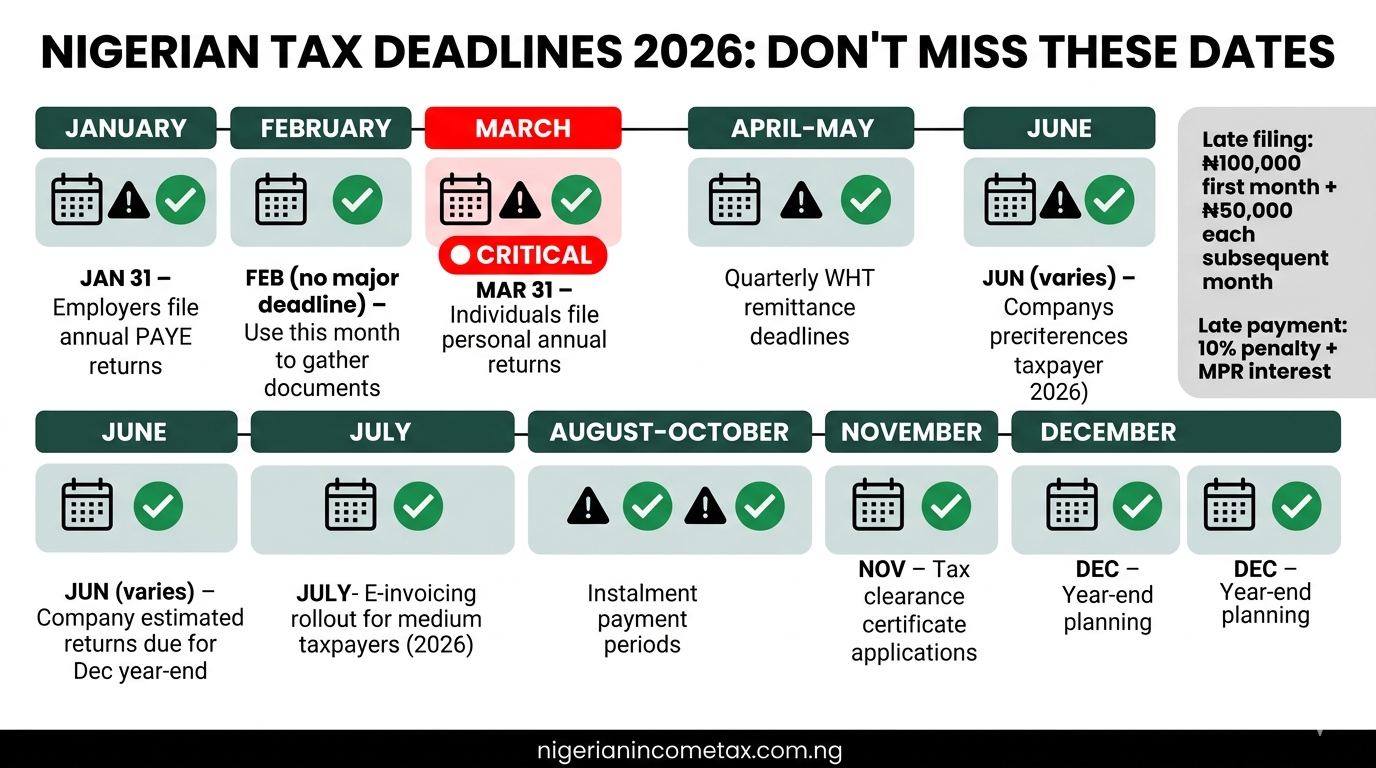
Key Deadlines to Remember
| Who | What | When | Penalty for Non-Compliance |
|---|---|---|---|
| Employers | File annual PAYE returns | January 31 | ₦100,000 first month, ₦50,000 subsequent months |
| Employers | Monthly PAYE remittance | 10th of each month | 10% penalty + MPR interest; failure to deduct: 40% penalty |
| Individuals with side income | Personal annual return | March 31 | ₦100,000 first month, ₦50,000 subsequent months |
| Self-Employed | Annual return | March 31 | Same as above |
| Companies | Final returns | Within 6 months of year-end | Varies |
Missing these deadlines triggers penalties. According to KPMG Nigeria tax publications, the financial consequences of late filing can add up quickly—₦100,000 for the first month, then ₦50,000 for each subsequent month. Understanding the full range of penalty provisions helps you stay compliant.
Where to File
Personal Income Tax (Employees & Self-Employed)
File with the State Internal Revenue Service where you reside, not where you work.
- Lagos State: LIRS eTax portal (etax.lirs.net)
- FCT: fctirs.gov.ng
- Rivers State: rivtamis.riversbirs.gov.ng
- Kano State: kirs.gov.ng
The rules around which state gets your tax can be confusing, especially if you live in one state but work in another. Learning about the residency guidelines ensures you’re filing in the right place.
Company Income Tax
File with the Nigeria Revenue Service (NRS) —formerly FIRS—which handles federal taxes. The new framework includes a unified Single Tax Window for easier compliance.
What Happens After You File
If You Owe Tax
You’ll receive an assessment notice showing the amount due. Tax charged must be paid within 30 days of service of the notice. Pay by the deadline to avoid penalties and interest.
If You’re Audited
Some returns are selected for audit. This doesn’t mean you did anything wrong—it’s a standard verification process. Provide the requested documents promptly. If you disagree with the findings, you have 30 days to object.
Facing an audit can be stressful, but knowing what to expect makes it manageable. The process is explained in detail in our guide on tax audit procedures.
Common Filing Mistakes
Mistake 5: Ignoring Digital Assets
Crypto gains are taxable under the Nigeria Tax Administration Act 2025. Exchanges must report all transactions linked to your TIN and NIN. If you traded crypto, you must report it. The rules around digital asset taxation have changed significantly.
These errors are more common than you might think. Reading through examples of what others have gotten wrong can help you avoid the same fate. The most frequent filing errors section covers these in more detail.
Digital Filing: The 2026 Transformation
The 2026 reforms emphasize digital transformation:
- E-invoicing mandatory for VAT-registered businesses
- Single Tax Window for unified compliance
- Online portals for most state IRS (LIRS eTax portal allows registration, filing, and document upload)
- Automated bank reporting of transactions exceeding ₦25 million monthly
For companies, this signals a shift away from manual processes. Kenneth Erikume, tax reporting and strategy lead at PwC Nigeria tax publications, noted that companies failing to digitize risk falling behind.
Keeping up with technological advances in tax administration will become increasingly important in the coming years.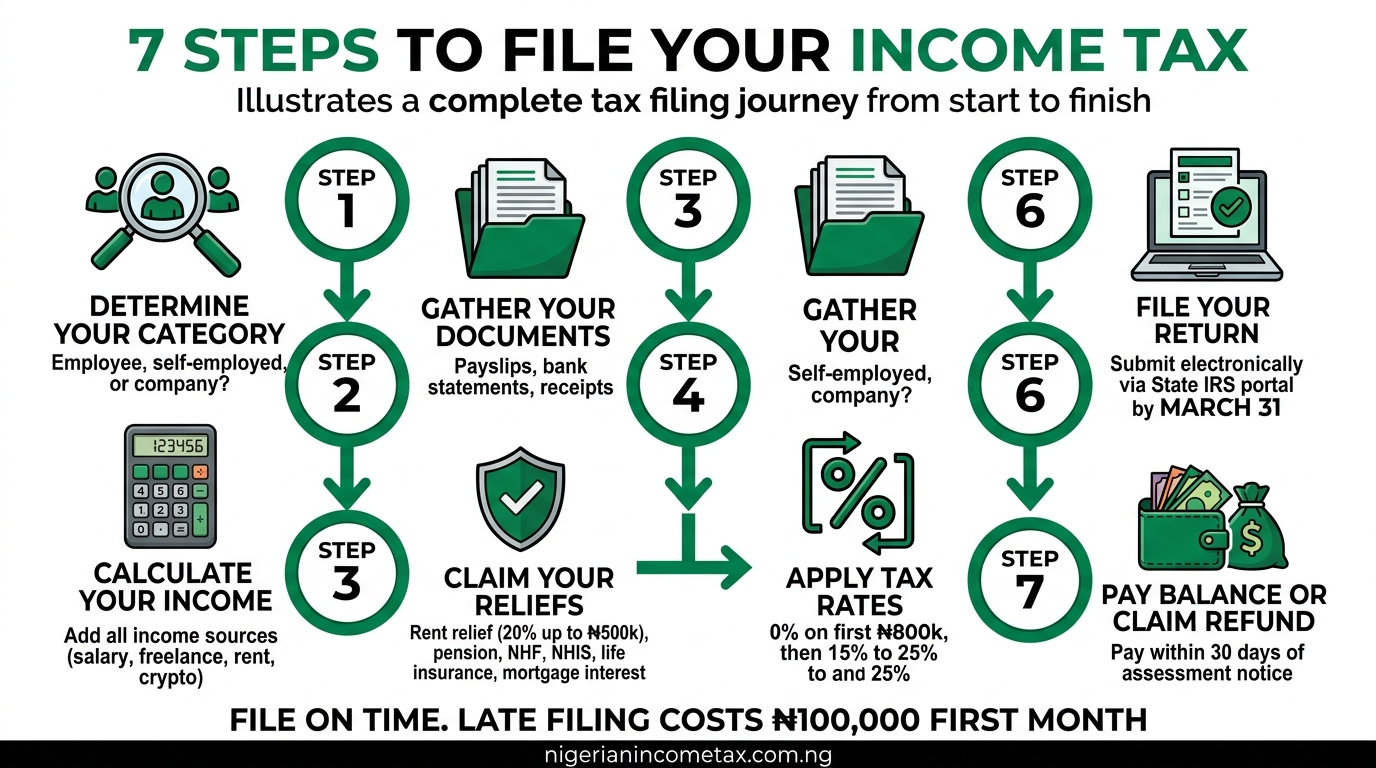
The Bottom Line
Filing income tax in Nigeria isn’t one-size-fits-all:
- Employees have tax deducted automatically but must file if they have other income
- Self-employed individuals file direct assessments and pay in installments
- Companies file estimated and final returns based on their accounting year
- Everyone must file by March 31 (individuals) or within six months of year-end (companies)
Leave a Reply