Most people interact with tax the way they interact with gravity—they feel its effects without ever understanding why it works the way it does.
But here’s the thing: tax laws aren’t random. They’re not designed to confuse you (even if it sometimes feels that way). Behind every rule, every rate, every exemption, there’s a principle. A reason. A purpose.
Understanding those principles won’t make your tax bill disappear. But it will help you see why some income is taxed and some isn’t. Why reliefs exist. Why the government cares about where you live. And most importantly, it helps you predict how changes might affect you.
Let’s walk through the core principles that shape Nigerian tax laws under the Nigeria Tax Act 2025, effective from January 2026.
Principle 1: Ability to Pay
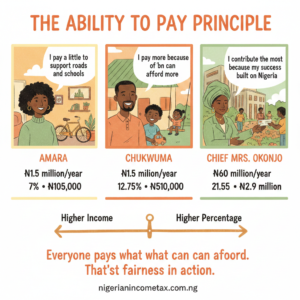
The most fundamental principle in Nigerian taxation is that tax should be based on what you can afford to pay.
This is why we have progressive tax rates. Someone earning ₦500 million annually doesn’t need that money for basic survival the way someone earning ₦500,000 does. The higher earner can afford to contribute a larger percentage of their income to fund public services.
The 2026 rates reflect this clearly:
| Income Level | Tax Rate |
|---|---|
| First ₦800,000 | 0% |
| ₦800,001 – ₦3,000,000 | 15% |
| ₦3,000,001 – ₦12,000,000 | 18% |
| ₦12,000,001 – ₦25,000,000 | 21% |
| ₦25,000,001 – ₦50,000,000 | 23% |
| Above ₦50,000,000 | 25% |
Higher income = higher percentage. That’s ability to pay in action.
This principle also explains why the first ₦800,000 is completely tax-free. Everyone needs a basic amount to live on. The government doesn’t tax survival money.
To understand how this affects you across all income levels, you need to understand how personal income tax works in Nigeria.
Principle 2: Certainty
A tax system only works if people know what they owe. Certainty means:
- You should know when to pay
- You should know how much to pay
- You should know how to pay
- The rules shouldn’t change without notice
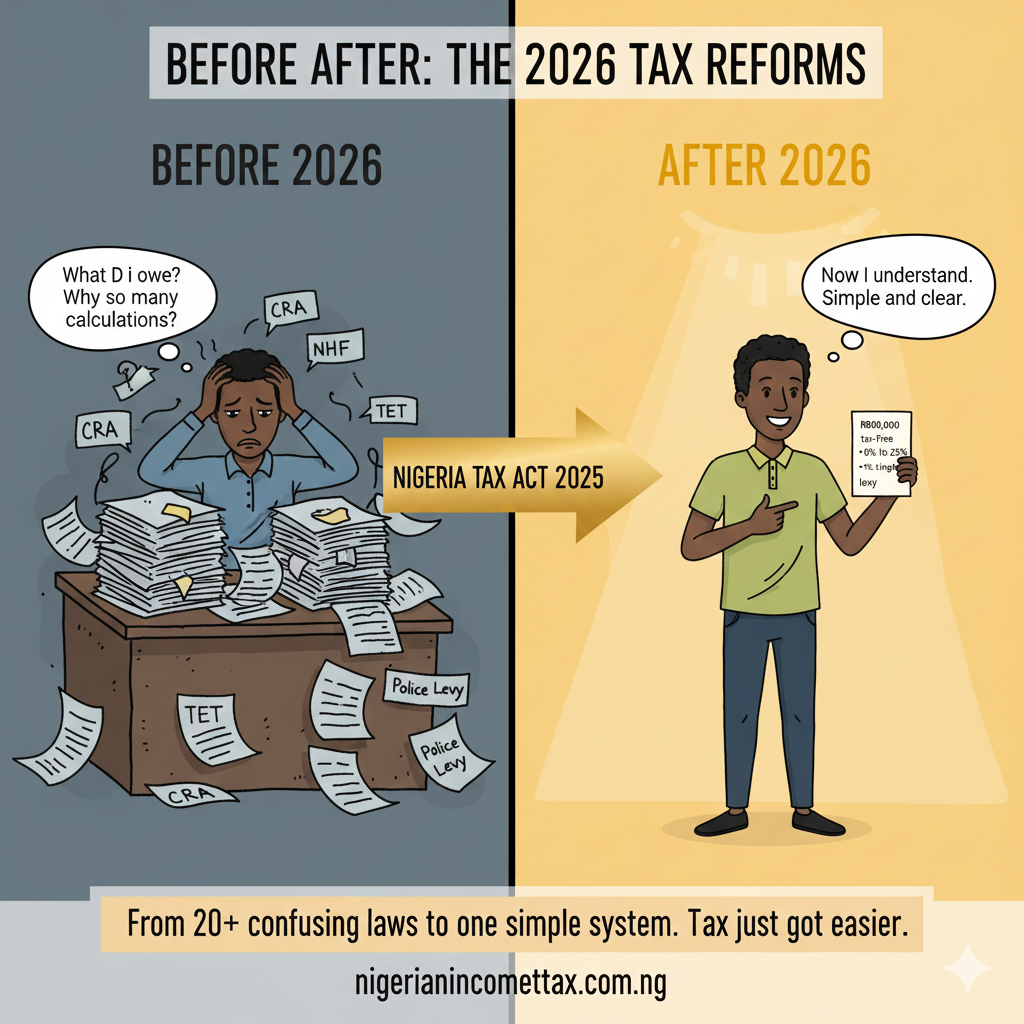
This is why the 2026 reforms simplified the old Consolidated Relief Allowance system. Under the old rules, calculating your tax-free amount required math that many people found confusing. Now it’s simple: the first ₦800,000 is tax-free. Full stop.
Certainty also explains why tax authorities publish guidelines, circulars, and public notices. The Nigeria Tax Act 2025 consolidates over 20 tax laws into a single unified framework, reducing ambiguity and promoting consistency. You can look up exactly what you owe by checking the current income tax rates published by the authorities.
When tax laws are uncertain, people make mistakes. They overpay or underpay. Both are bad for everyone.
Principle 3: Convenience
Tax should be paid in a way that’s convenient for the taxpayer, not just for the government.
This is why PAYE exists. Instead of making every employee file a return and write a cheque to the government each month, your employer handles it automatically. The tax comes off your salary before you ever see it. It’s convenient because you don’t have to think about it.
For self-employed people, convenience means installment payments. You don’t have to find a huge lump sum once a year. You can pay in bits throughout the year as your income comes in.
This convenience factor is built into the system, which is why understanding how PAYE is calculated helps you verify your payslip.
For businesses, convenience means filing online, making electronic payments, and dealing with a single tax authority instead of multiple ones. The Nigeria Revenue Service (NRS), which replaced FIRS, has invested heavily in making compliance easier through mandatory e-invoicing and electronic fiscal systems.
Principle 4: Economy
The cost of collecting tax shouldn’t exceed the amount collected.
This sounds obvious, but it’s a real constraint. If it costs the government ₦100 to collect ₦50 of tax, something is wrong.
This principle explains why:
- Small companies are exempt from many taxes. The cost of auditing every small business would outweigh any revenue gained. Under the NTA 2025, small companies (≤ ₦50 million turnover and ≤ ₦250 million fixed assets) are exempt from CIT, CGT, and development levy.
- Minimum wage earners pay nothing. Collecting small amounts from millions of low-income workers would cost more than it’s worth. The first ₦800,000 is tax-free.
- PAYE is mandatory for employers. It’s cheaper for the government to collect tax from 100,000 employers than from 10 million employees.
This principle balances with the need for everyone to contribute, which is why minimum tax exists even for loss-making companies.
Principle 5: Equity
Equity in taxation means two things:
Horizontal equity: People in similar situations should pay similar tax. If two people earn the same income, they should generally pay the same tax.
Vertical equity: People in different situations should pay different tax. Higher earners should pay more, both in absolute terms and as a percentage.
This is why reliefs exist. If you pay rent, you get rent relief (20% of annual rent up to ₦500,000). If you contribute to pension, you get pension relief (8% of basic + housing + transport). These recognize that people with identical salaries may have very different financial realities.
The NTA 2025 strengthens equity by removing the Consolidated Relief Allowance and replacing it with targeted reliefs that require documentary evidence. The tax system creates equity through various reliefs and allowances that reduce your taxable income.

Equity also explains why your state of residence determines where your tax goes, not where you work. Your tax should go to the state that provides you services—the roads you drive on, the schools your children attend, the hospitals you use. Paying where you live, not where you work, ensures that connection.
Principle 6: Neutrality
Tax shouldn’t distort economic decisions. Ideally, you should make business and investment choices based on what makes sense for your situation, not because of tax consequences.
In reality, perfect neutrality is impossible. But tax laws try to minimize distortion.
For example, the 2026 rules tax cryptocurrency gains the same way they tax other investment income. Digital assets including crypto, NFTs, and tokens are now explicitly included in chargeable income. This is neutral—it doesn’t favor crypto over other investments or vice versa.
Similarly, the 0% rate for small companies doesn’t distort decisions about business size. It encourages growth without punishing success.
Neutrality in business taxation means understanding how corporate income tax applies to your company structure.
Principle 7: Flexibility
Tax laws need to adapt to changing circumstances. An economy in 1980 is different from an economy in 2026.
This is why the 2026 reforms happened. The old system, designed decades ago, no longer fit:
- Digital assets didn’t exist when the old rules were written
- Remote work wasn’t common
- The economy had grown and changed
- International tax standards had evolved
Flexibility means new rules for new realities: crypto taxation, remote employee rules, digital economy provisions, and a 15% minimum effective tax rate for large multinational groups aligned with the OECD Pillar 2 framework.
The NTA 2025 also introduces Controlled Foreign Company (CFC) rules to tax undistributed profits of foreign subsidiaries controlled by Nigerian companies. This prevents profit shifting to low-tax jurisdictions.
Flexibility in addressing new assets means your crypto earnings are now taxed like other investment income.
Principle 8: Simplicity
This is the newest principle, and the 2026 reforms embrace it fully.
The old tax system was complicated. Multiple reliefs, confusing calculations, overlapping levies. Even professionals sometimes struggled.
The 2026 system is deliberately simpler:
- One tax-free threshold (₦800,000) instead of CRA calculations
- One development levy (4%) instead of multiple separate levies (TET, IT Levy, NASENI Levy, Police Trust Fund Levy)
- Clear, progressive rates (0% to 25%)
- Electronic filing and payment
- Mandatory e-invoicing for VAT-registered businesses
The NTA 2025 consolidates over 20 tax-related laws into a single unified framework. Rather than navigating multiple statutes, taxpayers now work within a single legal framework, promoting consistency and reducing ambiguity.
Step-by-step instructions on how to file are available for both individuals and businesses.
New Principles in the 2026 Reforms
Transparency and Accountability
The NTA 2025 introduces new mechanisms to rebuild trust in the tax system:
- Tax Ombud Office: An independent and impartial arbiter to review and resolve complaints from aggrieved taxpayers
- Joint Revenue Board: Replaces the Joint Tax Board to coordinate tax administration across all levels of government
- Whistleblower incentives: The NRS can reward individuals who provide useful information leading to tax recovery
Tax compliance is endogenous to trust in public institutions. Studies consistently show that citizens are more willing to comply when taxation is perceived as fair and when public services are visibly improved.
Global Alignment
The 2026 reforms align Nigeria with international best practices:
- 15% minimum effective tax rate for multinational groups (OECD Pillar 2)
- Controlled Foreign Company (CFC) rules to prevent profit shifting
- Force of attraction rule expanding non-resident taxable scope
- EPC contracts taxable even if partly performed offshore
- Significant economic presence rules for digital services
These international alignments become clear when you look at a tax system comparison between Nigeria and other countries.
How These Principles Work Together
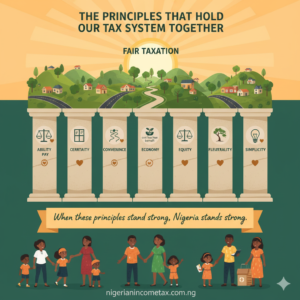
No single principle dominates. They balance each other:
- Ability to pay says higher earners should pay more
- Economy says collecting from everyone costs too much
- Equity says similar people should pay similarly
- Simplicity says rules should be easy to follow
- Flexibility says rules should adapt to change
Sometimes principles conflict. When they do, tax laws make trade-offs.
The 2026 reforms tried to strike the right balance:
- Higher earners pay more (ability to pay)
- Small companies are exempt (economy)
- Rent relief exists (equity)
- The ₦800,000 threshold is simple (simplicity)
- Crypto is now taxable (flexibility)
- Tax Ombud ensures accountability (transparency)
- Global minimum tax aligns with international standards (global alignment)
Why Understanding Principles Matters
Knowing these principles won’t make you a tax expert. But it will help you:
- Predict changes – When the economy shifts, you’ll have some idea how tax laws might adapt
- Understand your obligations – The rules make more sense when you know why they exist
- Plan better – You can see the logic behind reliefs and use them strategically
- Spot unfairness – If a rule seems to violate basic principles, it might be worth questioning
- Engage with the system – Tax isn’t just something that happens to you. It’s how we fund the society we share
When people don’t understand these principles, they often make common mistakes that lead to overpaying or penalties.

The Bottom Line
Nigerian tax laws aren’t random. They’re built on principles that have evolved over decades:
- Ability to pay – More income, higher percentage
- Certainty – You should know what you owe
- Convenience – Pay in ways that work for you
- Economy – Don’t spend more to collect than you get
- Equity – Treat similar people similarly
- Neutrality – Don’t distort economic choices
- Flexibility – Adapt to changing times
- Simplicity – Make it easy to comply
- Transparency – Build trust through accountability
- Global alignment – Meet international standards
The 2026 reforms strengthened some of these principles (simplicity, flexibility, transparency) while maintaining others (ability to pay, equity).
Next time you look at your payslip and wonder why a rule exists, ask yourself: which principle does this serve? The answer is usually there, even if it’s not obvious at first glance.
Tax is how we pay for the society we want to live in. Understanding the principles behind it doesn’t make paying easier. But it makes the whole system feel less like something done to you and more like something we all participate in.
Practical compliance information can be found at the Lagos State Internal Revenue Service website.
Last updated: March 2026
This article reflects the provisions of the Nigeria Tax Act 2025 (effective January 2026), the Nigeria Tax Administration Act 2025, the Nigeria Revenue Service (Establishment) Act 2025, and the Joint Revenue Board (Establishment) Act 2025.
Leave a Reply